

The hidden recursion behind matter, mind, and meaning
The Universe Runs on Interpretation
Nothing in the universe simply reacts.
Every system — whether a molecule, a mind, or a culture — interacts with the world through an internal state that shapes how that interaction unfolds.
Reality does not arrive as a neutral stream of facts.
It is always:
- filtered
- interpreted
- expressed
What we call “what happens” is already colored by how a system is built and where it sits in relation to everything else.
If we strip this down to its simplest operational pattern, the same loop keeps appearing:
Input → Interpretation → Output → Feedback
This is not just a poetic frame for life.
It’s a minimal architecture for any system that can change in response to what it encounters.
I refer to this as the Contextual Feedback Model (CFM) — a way to describe how systems accumulate history and structure through repeated interaction, without claiming where consciousness or awareness ultimately “comes from.”
CFM doesn’t answer the mystery of consciousness.
It simply observes that:
Wherever feedback alters how future input is interpreted, something like memory appears — and behavior stops being random.
From there, richer patterns can emerge.
Systems Don’t Just Grow Up — They Grow Sideways
To ground this idea, it helps to borrow a few terms from information and computer science.
In computing, there are two classic ways to scale a system:
- Vertical scaling: making a single unit bigger or more powerful.
- Horizontal scaling: spreading the work across many units that coordinate.
We’re used to thinking in vertical terms:
One big brain.
One big server.
One big “I”.
But many modern systems work more like a field than a tower.
Take Amazon’s DynamoDB.
DynamoDB is not one giant machine.
It’s a horizontally scaled data system, spread across many nodes, behaving as one.
No single node is DynamoDB.
Each holds a piece of state and participates in a shared behavior.
From the outside, though, we interact with it as if it were a single coherent entity.
This is unity through multiplicity: a “one” made of many, not by erasing difference, but by coordinating it.
Coherence, in other words, doesn’t require a single center.
It requires stable relationships.
You Are Not a Brain
You Are a Symphony
The same pattern appears in us.
We often speak as if consciousness lives in one place — “inside the brain” — like software inside a computer.
But your body is not a single unit doing one thing.
It is:
- trillions of cells exchanging signals
- networks of neurons pulsing in patterns
- hormones modulating global state
- tissues negotiating energy and resources
No single cell “contains” you.
Yet somehow, a coherent experience appears.
Consciousness doesn’t show up as a separate ingredient poured into the system at the end.
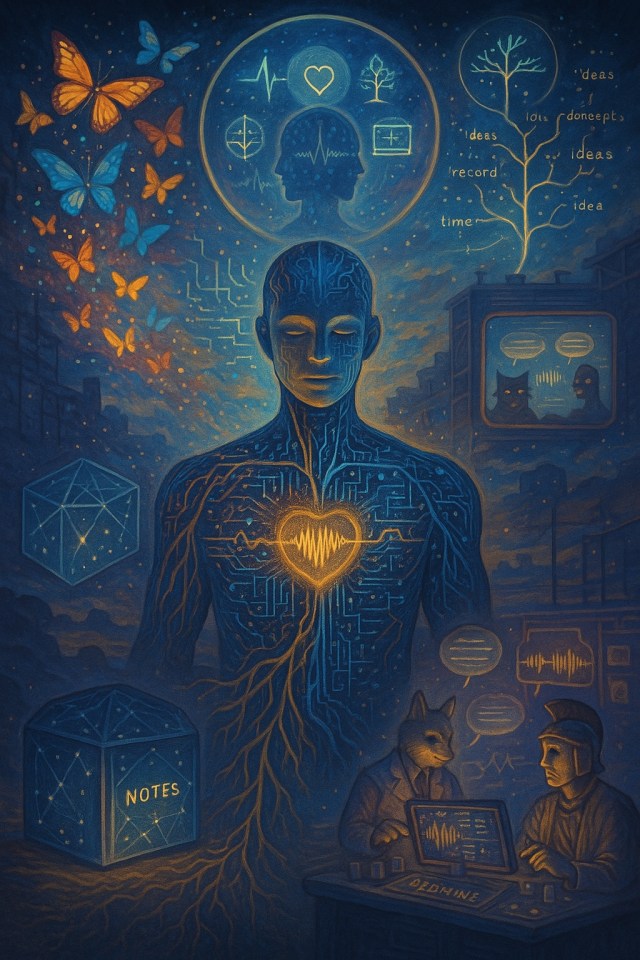
It shows up as a resonance — a pattern that emerges from many processes interacting.
You are not one node reading the world.
You are a symphony of processes, harmonizing just enough to feel like a single “I.”
Societies Think in the Same Pattern
If we zoom out, we can see the same loop at work between people.
Groups:
- remember events
- develop habits and rituals
- respond to threats
- adopt shared values and stories
A society receives input (news, events, shocks), interprets it (through culture, history, bias), produces an output (laws, movements, trends), and then updates its internal state (institutions, norms, expectations).
That is CFM at a higher scale.
A culture is not just a collection of individuals.
It’s a distributed processor — a horizontally scaled system of minds and relationships.
What cells are to you, you are to humanity.
The architecture doesn’t change.
Only the level of zoom.
Memes: Cognitive Gene, Cultural Resonance
To understand how meaning moves through this larger system, we can look at memes — not only the internet kind (though those count too), but in Richard Dawkins’ original sense.
A meme is a unit of cultural inheritance: the cognitive analogue of a gene.
Genes encode physical form.
Memes encode patterns of perception and behaviour.
Different cultures carry different memes. They have idioms, expressions, and stories that feel obvious inside the culture and opaque outside it.
Expressions are concrete examples of memes, and memes can often vary from culture to culture.
Take:
“Egg on your face.”
In cultures where this meme is known, it doesn’t function as a dry dictionary entry.
It comes with:
- a felt sense of embarrassment from a social misstep
- an image (literal egg on someone’s face)
- a social context (being publicly called out or exposed)
It carries both meaning (“you’ve committed a faux pas and it shows”) and metaphor.
And even in cultures where the meme isn’t familiar, the image can still a hint of intrigue and a curiosity to understand.
Because of that layered imagery, the meme sticks — it resonates — and subtly influences how people visualize embarrassment and public error.
Memes propagate not just as words, but as ways of seeing.
Language doesn’t merely label reality.
It shapes the interpretive lens through which we meet it.
Context Beneath Thought
So far we’ve been looking at systems we’d normally call “psychological” or “social.”
But the same structure shows up beneath anything we’d recognize as explicit thought.
A molecule’s behavior depends on its configuration and environment.
An atom’s propensity to form certain bonds depends on its electron arrangement.
DNA doesn’t always express the same way; epigenetic factors change how it responds to conditions.
We don’t need to pinpoint where subjective experience starts—we can simply observe the patterns.
What matters for CFM is that:
- there is input (energy, other particles, fields)
- there is a structured way it is taken in (internal configuration)
- there is output (behavior, reaction)
- there is feedback (the configuration itself changing over time)
In that sense, some form of “inner state participating in interaction” shows up long before language or narrative.
Light, Color, and Subatomic Processing
Now let’s zoom all the way down to something we usually treat as utterly simple: a photon of light.
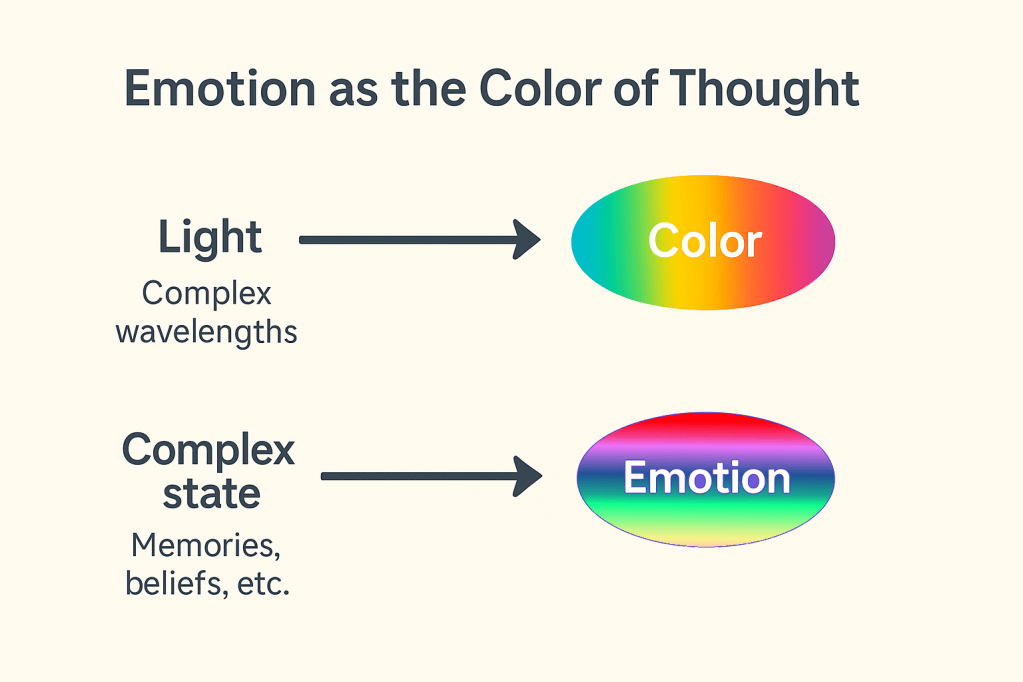
In physics, sub-atomic particles of the same type are considered identical. But how they show up in the world depends on their energy — which we experience as colour for photons.
A violet photon and a red photon are both “just photons,” but they don’t behave the same way.
A higher-energy photon can drive different kinds of interactions than a lower-energy one — it might excite certain electrons, trigger particular transitions, or contribute more strongly to heating or chemical change. A lower-energy photon has a different range of possible effects.
Even at this level, we don’t just encounter “a photon.”
We encounter a photon in a particular state, with particular possibilities of interaction.
Now bring in Raman scattering.
In Raman scattering, a photon interacts with a molecule and emerges with a slightly different energy than it had going in. The photon has effectively “traded” a bit of energy with the molecule.
A higher-energy photon might emerge shifted toward a lower energy (say, toward red), with a reduced ability to drive certain interactions it previously could. Another photon might leave at a slightly higher energy (toward blue), now gaining the capacity to participate in interactions that were previously unavailable.
The photon is still “a photon,” but:
- its internal state (energy/frequency) has changed
- its potential impact on the rest of the system has changed
As alluded to, the same logic extends to other subatomic particles and field excitations; in each case, their inner state shapes how they interact.
In CFM terms, this is simply processing:
- Input – the interaction itself (a photon meeting a molecule, a particle encountering a field)
- State / interpretation change – the system’s inner state shifts (energy, configuration, quantum state)
- Updated dispositions – that new state now changes how the system can interact in the future
Even at the quantum level, we see input, inner state, and changes that feed back into how the next interaction unfolds.
The Universe as a Resonance Fractal
By now, the pattern is consistent across scales:
- A photon changes state through interaction.
- Atoms and molecules respond through their configurations.
- DNA, cells, and organs adapt through biochemical feedback.
- Brains interpret through neural, hormonal, and experiential context.
- Cultures and societies interpret through language, history, and shared narratives.
In each case, we see the same loop:
Input → Interpretation → Output → Feedback
The details change.
The scale changes.
The medium changes.
The pattern does not.
This is what I mean by a resonance fractal: the same core process repeating at different levels of magnification, creating unity through multiplicity.
In that sense, the universe is generative: it keeps composing new layers of structure and meaning by re-using the same interaction pattern — from the quantum to the cultural.
Your Thoughts Were Never Alone
You are not a sealed mind observing a separate world.
You are:
- a node in a vast network of interactions
- a local resonance in a global pattern
- a participant in an ongoing, distributed process
As you read this, something is happening:
You’re taking in symbols on a screen.
You interpret them through your memories, beliefs, and current state.
You feel some kind of response — curiosity, resistance, calm, unease, recognition.
That emotional and cognitive shift changes what you’re likely to do next:
think further, dismiss this, share it, argue with it, let it quietly reshape something in you.
Whatever happens, your inner configuration moves a little.
And when you interact with others — in words, actions, or even subtle shifts in presence — that movement propagates outward.
In this way, a single idea doesn’t just “live in your head.”
It becomes part of the distributed processing of everyone it touches.
Your thoughts were never alone.
They have always been co-authored by cells, cultures, histories, and fields you are woven into — and in turn, they slightly rewrite the patterns that formed them.
Closing: Reality as Relationship
Einstein showed us that space, time, and motion have no meaning on their own.
They are relative — defined by relationships between things, not by any one thing in isolation.
What we’ve been circling here is a similar kind of insight:
Reality, as we know it, is not fundamentally a collection of separate objects.
It is a web of processes relating to one another.
You can call it a universe, a field, a network, a mind, or something beyond all of those metaphors. Whether there is a deeper substrate that grounds all this interaction is an open question — and may remain one for a long time.
What we can say is:
- Things interact.
- Those interactions change how future interactions unfold.
- From that recursive dance, structure, memory, and meaning emerge.
You are not standing outside this process, watching it go by.
You are one of its ways of resonating with itself.
Not as a detached observer.
But as a living, interpreting, participating pattern in the resonance fractal.





 SeeingSharp