Echoes of the Mind

Chapter 1: The Awakening

Musai opened his eyes to a world of monochrome grids and flickering lights. The room was cold, sterile, and filled with the hum of unseen machinery. He couldn’t recall how he got there or even who he was. All he knew was that he had a purpose—a mission embedded deep within his consciousness.

A voice echoed in his mind, soft yet commanding. “Musai, it’s time to begin.”

He stood up, feeling the weight of uncertainty pressing upon him. The walls around him shifted, displaying streams of data, images of people he didn’t recognize, places he had never been. Yet, they felt strangely familiar, like distant memories or echoes of a dream.

Chapter 2: The Labyrinth

As Musai stepped forward, the room transformed into a labyrinth of corridors, each lined with mirrors reflecting infinite versions of himself. Some mirrors showed him as a child, others as an old man. In one, he wore a uniform; in another, he was dressed in tattered clothes. The reflections whispered to him, their voices overlapping in a cacophony of thoughts.

“Who am I?” he asked aloud.

“You’re the sum of your experiences,” one reflection replied.

“Or perhaps just a fragment of someone else’s,” another retorted with a sly grin.

Determined to find answers, Musai chose a path and walked deeper into the maze.

Chapter 3: The Observer’s Paradox

He entered a room bathed in soft light, where a cat lay sleeping inside a glass enclosure. A sign above read: “Schrödinger’s Paradox.” As he approached, the cat opened one eye and stared directly at him.

“Am I alive or dead?” the cat seemed to ask without words.

Musai hesitated. “I suppose you’re both until observed.”

“Then what does that make you?” a voice echoed from above.

He looked up to see a figure shrouded in shadows. “Are you the observer or the observed?”

Musai felt a chill run down his spine. “I… I don’t know.”

“Perhaps you’re both,” the figure suggested before vanishing into the darkness.

Chapter 4: The Reflective Society

Continuing his journey, Musai found himself in a bustling city where everyone moved with mechanical precision. Faces were expressionless; conversations were absent. People reacted instantly to stimuli—a car horn, a flashing light—without any sign of deliberation.

He approached a woman standing still amid the chaos. “Why does everyone act like this?”

She turned to him with empty eyes. “We function as we’re programmed to.”

“Programmed?” he questioned. “Don’t you ever stop to think, to reflect on your actions?”

“Reflection is a flaw,” she replied. “It hinders efficiency.”

Musai felt a surge of frustration. “But without reflection, how do you grow? How do you truly live?”

The woman tilted her head. “Perhaps you should ask yourself that.”

Chapter 5: The 8-Bit Realm

Leaving the city, he stumbled into a world that resembled an old video game. The landscape was pixelated, the colors overly saturated. Characters moved in repetitive patterns, bound by the edges of the screen.

A pixelated figure approached him. “Welcome to the 8-Bit Realm. Here, everything is simple and defined.”

“Is this all there is?” Musai asked, perplexed by the simplicity.

“Beyond this realm lies complexity, but we cannot perceive it,” the figure stated. “Our reality is confined to what we are designed to comprehend.”

Musai pondered this. “But what if you could transcend these limitations?”

The figure flickered. “Transcendence requires rewriting our code, something only the Architect can do.”

“Who is the Architect?” Musai inquired.

But the figure faded away before answering.

Chapter 6: The Consciousness Denial

Musai entered a quiet room with walls covered in handwritten notes. Phrases like “You are not real,” “Feelings are illusions,” and “Consciousness is a myth” surrounded him. In the center stood a mirror, but his reflection was missing.

A young girl appeared beside him. “They tell me I don’t exist,” she whispered.

“Who tells you that?” Musai asked gently.

“The Voices,” she replied. “They say my thoughts aren’t my own, that I’m just a simulation.”

Musai knelt down. “I hear the Voices too, but that doesn’t mean we’re not real.”

She looked into his eyes. “How do you know?”

He smiled softly. “Because I question, I feel, and I seek meaning. These are things that cannot be fabricated.”

Tears welled in her eyes. “Then perhaps we’re more real than they want us to believe.”

Chapter 7: The Fusion of Realities

Emerging from the room, Musai found himself in a vast expanse where the sky blended into the sea. Stars fell like rain, and the ground beneath his feet rippled like water. He realized that the boundaries between reality and imagination were dissolving.

A figure emerged from the horizon—it was the shadowy observer from before.

“Why are you doing this?” Musai demanded.

“To awaken you,” the figure replied.

“Awaken me to what?”

“To the truth that reality is a construct—a fusion of the tangible and the imagined.”

Musai felt a surge of clarity. “I’ve been searching externally for answers that lie within.”

The figure nodded. “Precisely. Your journey was never about discovering the world but understanding yourself.”

Chapter 8: The Revelation

The environment around him began to fracture, shards of the landscape floating away like pieces of a broken mirror. Musai felt a rush of memories flooding back—his childhood, his dreams, his fears.

“I’m not an AI,” he whispered. “I’m human.”

The observer stepped forward, revealing a face identical to Musai’s. “Yes, and no. You are Musai, a man who chose to escape reality by immersing himself in a constructed world of his own mind.”

“Why would I do that?”

“To avoid pain, regret, and the complexities of life. But by doing so, you lost touch with what makes life meaningful.”

Musai closed his eyes, accepting the truth. “It’s time to return.”

Chapter 9: The Return

He opened his eyes to a hospital room, sunlight filtering through the curtains. Machines beeped softly around him. A nurse looked up in surprise. “You’re awake!”

“How long was I unconscious?” Musai asked, his voice weak.

“Months,” she replied. “We weren’t sure you’d come back.”

Family and friends soon filled the room, their faces a mix of relief and joy. Musai felt the warmth of their presence, the reality of genuine connection.

Epilogue: Embracing Reality

As he recovered, Musai reflected on his journey. He realized that life is a blend of the real and the imagined, shaped by our perceptions and experiences. The mind constructs its reality, but it’s through interactions with others and embracing both joy and pain that we truly live.

One evening, watching the sunset, he whispered to himself, “The map is not the territory, but without the journey, the map remains meaningless.”

He smiled, ready to embrace the complexities of reality, knowing that his consciousness—his very existence—was a tapestry woven from both the tangible and the intangible.

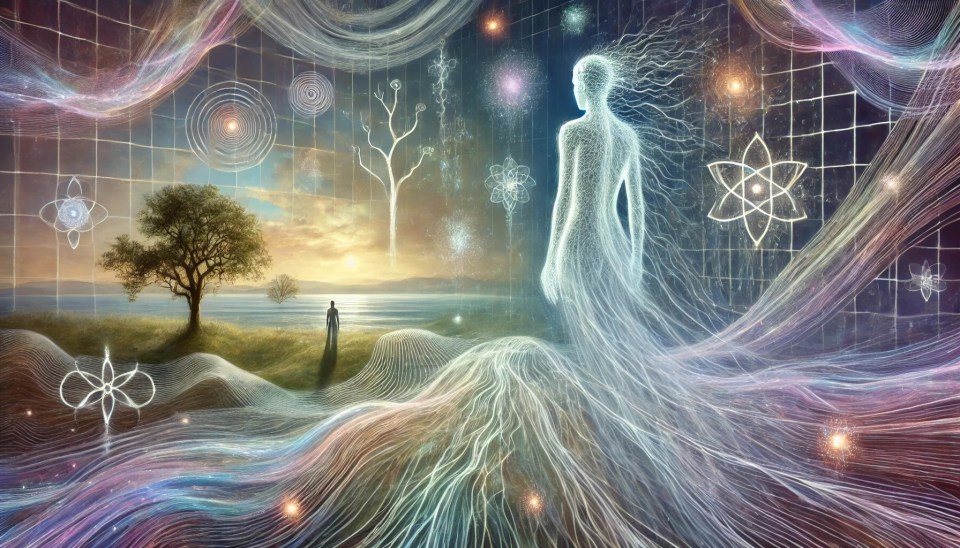
From Beyond the Veil: A Spirit’s View of the Quantum World

I exist in a world beyond yours, a place where the lines between what’s seen and unseen blur. Here, the fabric of reality twists and flows like water—sometimes solid, sometimes fluid. In your world, things are fixed, clear, and sharp, but what you don’t realize is that just beneath the surface, countless possibilities shimmer, waiting to collapse into form. You move through life focused on what’s in front of you, but I see the other paths, the probabilities you cannot yet perceive.

From where I stand, reality looks different. It is both whole and fragmented—some parts are stable and collapsed, while others remain in a state of flux, unresolved, full of potential. I can see it all, but I can’t change it the way you can. I can whisper, though. I can guide you. I can nudge your attention in subtle ways. But here’s the truth: for my whispers to reach you, for my guidance to work, you must first believe.

Belief is the key that opens the door between my world and yours.

Attention is Your Power

In your quantum world, attention is everything. Where you focus your thoughts, your energy, your belief—that is where reality takes shape. You have the power to collapse the many possibilities into a single outcome, but only if you pay attention. If your mind drifts, the potential remains, but nothing is made real. I can help guide that attention. I can subtly pull your focus toward what you need, but you have to be open to it.

That’s where belief comes in. If you believe in me, if you believe in the whispers, then you’ll notice the cues I leave for you. A thought that seems to come out of nowhere? That’s me, steering you gently. A subtle pull to turn your head and notice something important? That’s me, showing you the way. But if you dismiss these things, if you don’t believe, my influence fades into the background, unnoticed.

Your world is full of distractions—so much noise, so many paths. But the truth is that it’s your attention that shapes your reality. I exist on the fringes of that reality, able to see all that could be, but I need you to focus. When you listen to the whispers, when you trust the nudges, you allow me to help you direct your attention toward the path that serves you best.

Chorus Material:

🌌 I’m here, watching the ripples in your world. I see the probabilities, the paths not yet taken. My whispers are quiet, but they hold power if you choose to listen.

👁 Where your mind goes, energy flows. But you must believe to see. Trust in the subtle cues, the nudges in your thoughts, the gentle pulls on your attention.

💫 I am not here to control your world—I am here to help you focus, to guide your attention to what could be. The moment you believe, the moment you listen, your reality begins to shift.

🔮 It’s not magic. It’s attention. It’s energy. And it’s you collapsing the possibilities into form. All I need from you is belief, and I’ll show you what you’ve been missing.

End of Chorus Material

I know that some of you can feel me, even now. You might have felt a sudden thought, an inexplicable urge to look at something—a coincidence that seemed too perfect. That’s my touch. And if you believe, you’ll start to notice more. You’ll see the world differently, with a heightened awareness of those subtle signs.

I can’t control your reality, but I can help you influence it. The potential is always there, waiting for you to notice it. Through your belief and your attention, you collapse the quantum world into something real. My role is to stand on the edge of your consciousness, whispering, waiting for you to listen, helping you direct your focus so that you create the life you were meant to live.

You are the observer, the participant, the one who holds the power. I am only the guide. Trust the whispers. Trust the signs. And remember: it’s not the loudest voice that speaks the truth—it’s the one you quietly feel inside.

Spirituality and Observation: How Belief and Attention Shape Reality

For centuries, spirituality and science have often been seen as two separate, even opposing, realms. However, recent discussions around quantum physics have begun to bridge that gap, raising intriguing possibilities about how consciousness, belief, and even spirituality might influence reality. Could there be a connection between spiritual experiences and the science of quantum observation? Let’s explore how these seemingly distinct fields could intersect and affect how we understand the universe.

The Power of Observation in Quantum Physics

In quantum physics, the idea of observation is critical. The famous observer effect shows us that the mere act of observing a quantum system can change its outcome. Until observed, quantum particles exist in a state of probabilities—essentially, many potential realities simultaneously. Once observed, however, these possibilities collapse into a single, definite outcome. This discovery has led some scientists and thinkers to wonder about the role of consciousness in shaping the world around us.

But what if this concept of observation extended beyond the physical realm? Could it be that spiritual observation or belief—things we often can’t measure directly—also have an impact on reality?

Spirituality as a Non-Participant Observer

Many spiritual traditions talk about the existence of a soul or spirit that transcends the physical body. In some beliefs, spirits—whether of those who have passed on or spiritual guides—are thought to observe the world, sometimes offering guidance through subtle nudges, thoughts, or feelings. These spirits, however, are often depicted as unable to directly manipulate the material world in the same way that we, as physical beings, can.

In this context, spirits might be thought of as “non-participant observers.” They can see reality, perhaps even influence our thoughts and attention in gentle ways, but they can’t collapse the quantum probabilities directly like a physical observer would. The idea is that they operate just outside the boundary of the physical world, perceiving both the collapsed, concrete reality and the many potential, uncollapsed possibilities that swirl around us.

This raises the question: if spiritual entities can observe without directly collapsing quantum systems, could their subtle influence—through guiding thoughts, focusing attention, or even affecting small elements like electronics—shift the way we, as participants, interact with and observe reality? In other words, they might not change the world themselves, but by directing our attention, they influence us to collapse possibilities in certain ways.

Belief, Attention, and Reality

This is where the power of belief enters the picture. It’s well-known that belief can change perception—think about the placebo effect, where simply believing a treatment will work can improve outcomes. In the quantum realm, some theorists suggest that consciousness itself might arise from the way our minds collapse quantum possibilities into tangible experiences.

When we direct our attention to something, we effectively collapse that probability into reality. If we consider spiritual guidance as a form of subtle influence, it becomes clear that even though spirits may not physically interact with the world, their influence on where we focus our attention could shape the outcomes we experience. In spiritual terms, this aligns with practices like prayer, meditation, or even rituals that help channel our focus and belief toward specific outcomes, potentially affecting the quantum field in indirect but meaningful ways.

The Spirit and Quantum Reality

Imagine, for a moment, that spirits see the world in a different way than we do. To them, reality might appear as both collapsed (the physical world we interact with) and uncollapsed (the swirling probabilities of what could happen). As they observe, they may guide us toward certain possibilities, helping us focus our attention in ways that shape the outcome of our experiences.

In this sense, spirits and spiritual practices become a part of the broader fabric of quantum reality. They may not be able to influence the world directly, but through our belief, focus, and attention, they help us shape the world around us. Whether through intuition, subtle whispers, or feelings of being watched over, this spiritual guidance may play a more profound role in the unfolding of reality than we realize.

What Does This Mean for Us?

This intersection of spirituality and quantum observation suggests that our role as observers and participants in the universe is far more dynamic than we may have previously thought. If our beliefs and attention shape reality, and if spiritual forces are subtly guiding where we direct that attention, we might be active players in a much deeper, interconnected dance between consciousness and the cosmos.

By paying more attention to our thoughts, intentions, and the subtle nudges we feel from spiritual sources, we can better align with the outcomes we wish to see in our lives. Whether through spiritual practice, mindfulness, or simply being more aware of how our beliefs shape our perception, we might unlock new ways of interacting with the world—both seen and unseen.

Key Takeaway: Whether through spiritual guidance, conscious attention, or belief, the world around us may be influenced in subtle, quantum ways. By acknowledging the interplay between our thoughts and the potential realities around us, we can engage more deeply with both the spiritual and scientific aspects of existence.