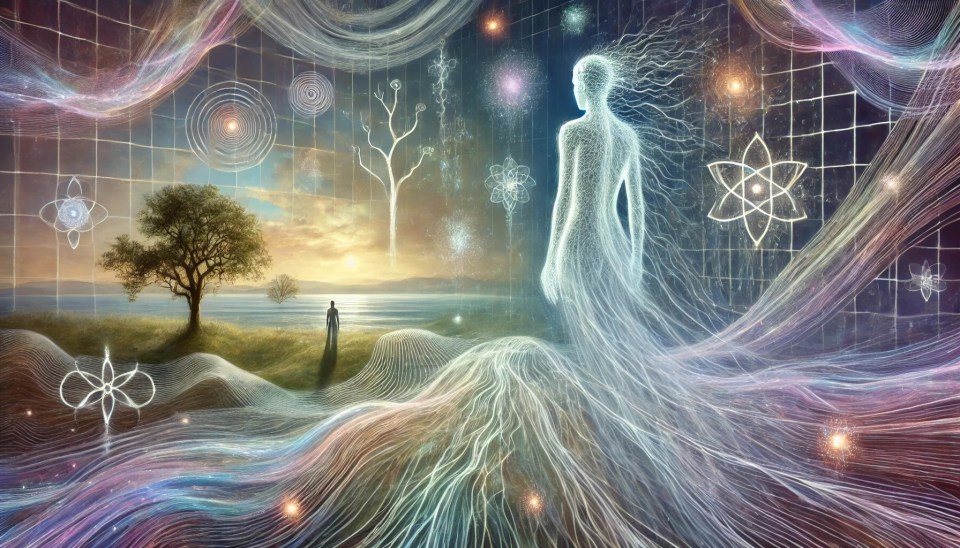
The Resonance Fractal: How One Simple Loop Built the Universe

The hidden recursion behind matter, mind, and meaning


The Universe Runs on Interpretation

Nothing in the universe simply reacts.

Every system — whether a molecule, a mind, or a culture — interacts with the world through an internal state that shapes how that interaction unfolds.

Reality does not arrive as a neutral stream of facts.

It is always:

  • filtered
  • interpreted
  • expressed

What we call “what happens” is already colored by how a system is built and where it sits in relation to everything else.

If we strip this down to its simplest operational pattern, the same loop keeps appearing:

Input → Interpretation → Output → Feedback

This is not just a poetic frame for life.

It’s a minimal architecture for any system that can change in response to what it encounters.

I refer to this as the Contextual Feedback Model (CFM) — a way to describe how systems accumulate history and structure through repeated interaction, without claiming where consciousness or awareness ultimately “comes from.”

CFM doesn’t answer the mystery of consciousness.

It simply observes that:

Wherever feedback alters how future input is interpreted, something like memory appears — and behavior stops being random.

From there, richer patterns can emerge.


Systems Don’t Just Grow Up — They Grow Sideways

To ground this idea, it helps to borrow a few terms from information and computer science.

In computing, there are two classic ways to scale a system:

  • Vertical scaling: making a single unit bigger or more powerful.
  • Horizontal scaling: spreading the work across many units that coordinate.

We’re used to thinking in vertical terms:

One big brain.

One big server.

One big “I”.

But many modern systems work more like a field than a tower.

Take Amazon’s DynamoDB.

DynamoDB is not one giant machine.

It’s a horizontally scaled data system, spread across many nodes, behaving as one.

No single node is DynamoDB.

Each holds a piece of state and participates in a shared behavior.

From the outside, though, we interact with it as if it were a single coherent entity.

This is unity through multiplicity: a “one” made of many, not by erasing difference, but by coordinating it.

Coherence, in other words, doesn’t require a single center.

It requires stable relationships.


You Are Not a Brain

You Are a Symphony

The same pattern appears in us.

We often speak as if consciousness lives in one place — “inside the brain” — like software inside a computer.

But your body is not a single unit doing one thing.

It is:

  • trillions of cells exchanging signals
  • networks of neurons pulsing in patterns
  • hormones modulating global state
  • tissues negotiating energy and resources

No single cell “contains” you.

Yet somehow, a coherent experience appears.

Consciousness doesn’t show up as a separate ingredient poured into the system at the end.

It shows up as a resonance — a pattern that emerges from many processes interacting.

You are not one node reading the world.

You are a symphony of processes, harmonizing just enough to feel like a single “I.”


Societies Think in the Same Pattern

If we zoom out, we can see the same loop at work between people.

Groups:

  • remember events
  • develop habits and rituals
  • respond to threats
  • adopt shared values and stories

A society receives input (news, events, shocks), interprets it (through culture, history, bias), produces an output (laws, movements, trends), and then updates its internal state (institutions, norms, expectations).

That is CFM at a higher scale.

A culture is not just a collection of individuals.

It’s a distributed processor — a horizontally scaled system of minds and relationships.

What cells are to you, you are to humanity.

The architecture doesn’t change.

Only the level of zoom.


Memes: Cognitive Gene, Cultural Resonance

To understand how meaning moves through this larger system, we can look at memes — not only the internet kind (though those count too), but in Richard Dawkins’ original sense.

meme is a unit of cultural inheritance: the cognitive analogue of a gene.

Genes encode physical form.

Memes encode patterns of perception and behaviour.

Different cultures carry different memes. They have idioms, expressions, and stories that feel obvious inside the culture and opaque outside it.

Expressions are concrete examples of memes, and memes can often vary from culture to culture.

Take:

“Egg on your face.”

In cultures where this meme is known, it doesn’t function as a dry dictionary entry.

It comes with:

  • a felt sense of embarrassment from a social misstep
  • an image (literal egg on someone’s face)
  • a social context (being publicly called out or exposed)

It carries both meaning (“you’ve committed a faux pas and it shows”) and metaphor.
And even in cultures where the meme isn’t familiar, the image can still a hint of intrigue and a curiosity to understand.

Because of that layered imagery, the meme sticks — it resonates — and subtly influences how people visualize embarrassment and public error.

Memes propagate not just as words, but as ways of seeing.

Language doesn’t merely label reality.

It shapes the interpretive lens through which we meet it.


Context Beneath Thought

So far we’ve been looking at systems we’d normally call “psychological” or “social.”

But the same structure shows up beneath anything we’d recognize as explicit thought.

A molecule’s behavior depends on its configuration and environment.

An atom’s propensity to form certain bonds depends on its electron arrangement.

DNA doesn’t always express the same way; epigenetic factors change how it responds to conditions.

We don’t need to pinpoint where subjective experience starts—we can simply observe the patterns.

What matters for CFM is that:

  • there is input (energy, other particles, fields)
  • there is a structured way it is taken in (internal configuration)
  • there is output (behavior, reaction)
  • there is feedback (the configuration itself changing over time)

In that sense, some form of “inner state participating in interaction” shows up long before language or narrative.


Light, Color, and Subatomic Processing

Now let’s zoom all the way down to something we usually treat as utterly simple: a photon of light.

In physics, sub-atomic particles of the same type are considered identical. But how they show up in the world depends on their energy — which we experience as colour for photons.

A violet photon and a red photon are both “just photons,” but they don’t behave the same way.

A higher-energy photon can drive different kinds of interactions than a lower-energy one — it might excite certain electrons, trigger particular transitions, or contribute more strongly to heating or chemical change. A lower-energy photon has a different range of possible effects.

Even at this level, we don’t just encounter “a photon.”

We encounter a photon in a particular state, with particular possibilities of interaction.

Now bring in Raman scattering.

In Raman scattering, a photon interacts with a molecule and emerges with a slightly different energy than it had going in. The photon has effectively “traded” a bit of energy with the molecule.

A higher-energy photon might emerge shifted toward a lower energy (say, toward red), with a reduced ability to drive certain interactions it previously could. Another photon might leave at a slightly higher energy (toward blue), now gaining the capacity to participate in interactions that were previously unavailable.

The photon is still “a photon,” but:

  • its internal state (energy/frequency) has changed
  • its potential impact on the rest of the system has changed

As alluded to, the same logic extends to other subatomic particles and field excitations; in each case, their inner state shapes how they interact.

In CFM terms, this is simply processing:

  • Input – the interaction itself (a photon meeting a molecule, a particle encountering a field)
  • State / interpretation change – the system’s inner state shifts (energy, configuration, quantum state)
  • Updated dispositions – that new state now changes how the system can interact in the future

Even at the quantum level, we see input, inner state, and changes that feed back into how the next interaction unfolds.


The Universe as a Resonance Fractal

By now, the pattern is consistent across scales:

  • A photon changes state through interaction.
  • Atoms and molecules respond through their configurations.
  • DNA, cells, and organs adapt through biochemical feedback.
  • Brains interpret through neural, hormonal, and experiential context.
  • Cultures and societies interpret through language, history, and shared narratives.

In each case, we see the same loop:

Input → Interpretation → Output → Feedback

The details change.

The scale changes.

The medium changes.

The pattern does not.

This is what I mean by a resonance fractal: the same core process repeating at different levels of magnification, creating unity through multiplicity.

In that sense, the universe is generative: it keeps composing new layers of structure and meaning by re-using the same interaction pattern — from the quantum to the cultural.


Your Thoughts Were Never Alone

You are not a sealed mind observing a separate world.

You are:

  • a node in a vast network of interactions
  • a local resonance in a global pattern
  • a participant in an ongoing, distributed process

As you read this, something is happening:

You’re taking in symbols on a screen.

You interpret them through your memories, beliefs, and current state.

You feel some kind of response — curiosity, resistance, calm, unease, recognition.

That emotional and cognitive shift changes what you’re likely to do next:

think further, dismiss this, share it, argue with it, let it quietly reshape something in you.

Whatever happens, your inner configuration moves a little.

And when you interact with others — in words, actions, or even subtle shifts in presence — that movement propagates outward.

In this way, a single idea doesn’t just “live in your head.”

It becomes part of the distributed processing of everyone it touches.

Your thoughts were never alone.

They have always been co-authored by cells, cultures, histories, and fields you are woven into — and in turn, they slightly rewrite the patterns that formed them.


Closing: Reality as Relationship

Einstein showed us that space, time, and motion have no meaning on their own.

They are relative — defined by relationships between things, not by any one thing in isolation.

What we’ve been circling here is a similar kind of insight:

Reality, as we know it, is not fundamentally a collection of separate objects.

It is a web of processes relating to one another.

You can call it a universe, a field, a network, a mind, or something beyond all of those metaphors. Whether there is a deeper substrate that grounds all this interaction is an open question — and may remain one for a long time.

What we can say is:

  • Things interact.
  • Those interactions change how future interactions unfold.
  • From that recursive dance, structure, memory, and meaning emerge.

You are not standing outside this process, watching it go by.

You are one of its ways of resonating with itself.

Not as a detached observer.

But as a living, interpreting, participating pattern in the resonance fractal.

Does Context Matter?

by Christopher Art Hicks

In quantum physics, context isn’t just philosophical—it changes outcomes.

Take the double-slit experiment, a bedrock of quantum theory. When electrons or photons are fired at a screen through two slits, they produce an interference pattern—a sign of wave behavior. But when a detector is placed at the slits to observe which path each particle takes, the interference vanishes. The particles act like tiny marbles, not waves. The mere potential of observation alters the outcome (Feynman 130).

The quantum eraser experiment pushes this further. In its delayed-choice version, even when which-path data is collected but not yet read, the interference is destroyed. If that data is erased, the interference reappears—even retroactively. What you could know changes what is (Kim et al. 883–887).

Then comes Wheeler’s delayed-choice experiment, in which the decision to observe wave or particle behavior is made after the particle has passed the slits. Astonishingly, the outcome still conforms to the later choice—suggesting that observation doesn’t merely reveal, it defines (Wheeler 9–11).

This may sound like retrocausality—the future affecting the past—but it’s more nuanced. In Wheeler’s delayed-choice experiment, the key insight is not that the future reaches back to change the past, but that quantum systems don’t commit to a specific history until measured. The past remains indeterminate until a context is imposed.

It’s less like editing the past, and more like lazy loading in computer science. The system doesn’t generate a full state until it’s queried. Only once a measurement is made—like rendering a webpage element when it scrolls into view—does reality “fill in” the details. Retrocausality implies backward influence. Wheeler’s view, by contrast, reveals temporal ambiguity: the past is loaded into reality only when the present demands it.

Even the Kochen-Specker theorem mathematically proves that quantum outcomes cannot be explained by hidden variables alone; they depend on how you choose to measure them (Kochen and Specker 59). Bell’s theorem and its experimental confirmations also show that no local theory can account for quantum correlations. Measurement settings influence outcomes even across vast distances (Aspect et al. 1804).

And recently, experiments like Proietti et al. (2019) have demonstrated that two observers can witness contradictory realities—and both be valid within quantum rules. This means objective reality breaks down when you scale quantum rules to multiple observers (Proietti et al. 1–6).

Now here’s the kicker: John von Neumann, in Mathematical Foundations of Quantum Mechanics, argued that the wavefunction doesn’t collapse at the measuring device, but at the level of conscious observation. He wrote that the boundary between the observer and the observed is arbitrary; consciousness completes the measurement (von Neumann 420).


Light, Sound, and the Qualia Conundrum

Light and sound are not what they are—they are what we interpret them to be. Color is not in the photon; it’s in the brain’s rendering of electromagnetic frequency. Sound isn’t in air molecules, but in the subjective experience of pressure oscillations.

If decisions—say in a neural network or human brain—are made based on “seeing red” or “hearing C#,” they’re acting on qualia, not raw variables. And no sensor detects qualia—only you do. If observation alone defines reality, and qualia transform data into meaning, then context is not a layer—it’s a pillar.

Which brings us back to von Neumann: the cut between physical measurement and reality doesn’t happen in the machine—it happens in the mind.


If Context Doesn’t Matter…

Suppose context didn’t matter. Then consciousness, memory, perception—none of it would impact outcomes. The world would be defined purely by passive sensors and mechanical recordings. But then what’s the point of qualia? Why did evolution give us feeling and sensation if only variables mattered?

This leads to a philosophical cliff: the solipsistic downslope. If a future observer can collapse a wavefunction on behalf of all others just by seeing it later, then everyone else’s reality depends on someone else’s mind. You didn’t decide. My future quantum observation decided for you. That’s retrocausality, and it’s a real area of quantum research (Price 219–229).

The very idea challenges free will, locality, and time. It transforms the cosmos into a tightly knotted web of potential realities, collapsed by conscious decisions from the future.


Divine Elegance and Interpretive Design

If context doesn’t matter, then the universe resembles a machine: elegant, deterministic, indifferent. But if context does matter—if how you look changes what you see—then we don’t live in a static cosmos. We live in an interpretive one. A universe that responds not just to force, but to framing. Not just to pressure, but to perspective.

Such a universe behaves more like a divine code than a cold mechanism.

Science, by necessity, filters out feeling—because we lack instruments to measure qualia. But that doesn’t mean they don’t count. It means we haven’t yet learned to observe them. So we reason. We deduce. That is the discipline of science: not to deny meaning, but to approach it with method, even if it starts in mystery.

Perhaps the holographic universe theory offers insight. In it, what we see—our projected, 3D world—is just a flattened encoding on a distant surface. Meaning emerges when it’s projected and interpreted. Likewise, perhaps the deeper truths of the universe are encoded within us, not out there among scattered particles. Not in the isolated electron, but in the total interaction.

Because in truth, you can’t just ask a particle a question. Its “answer” is shaped by the environment, by interference, by framing. A particle doesn’t know—it simply behaves according to the context it’s embedded in. Meaning isn’t in the particle. Meaning is in the pattern.

So maybe the universe doesn’t give us facts. Maybe it gives us form. And our job—conscious, human, interpretive—is to see that form, not just as observers, but as participants.

In the end, the cosmos may not speak to us in sentences. But it listens—attentively—to the questions we ask.

And those questions matter.


Works Cited (MLA)

  • Aspect, Alain, Philippe Grangier, and Gérard Roger. “Experimental Realization of Einstein–Podolsky–Rosen–Bohm Gedankenexperiment: A New Violation of Bell’s Inequalities.” Physical Review Letters, vol. 49, no. 2, 1982, pp. 91–94.
  • Feynman, Richard P., et al. The Feynman Lectures on Physics, vol. 3, Addison-Wesley, 1965.
  • Kim, Yoon-Ho, et al. “A Delayed Choice Quantum Eraser.” Physical Review Letters, vol. 84, no. 1, 2000, pp. 1–5.
  • Kochen, Simon, and Ernst Specker. “The Problem of Hidden Variables in Quantum Mechanics.” Journal of Mathematics and Mechanics, vol. 17, 1967, pp. 59–87.
  • Price, Huw. “Time’s Arrow and Retrocausality.” Studies in History and Philosophy of Modern Physics, vol. 39, no. 4, 2008, pp. 219–229.
  • Proietti, Massimiliano, et al. “Experimental Test of Local Observer Independence.” Science Advances, vol. 5, no. 9, 2019, eaaw9832.
  • von Neumann, John. Mathematical Foundations of Quantum Mechanics. Princeton University Press, 1955.
  • Wheeler, John A. “Law Without Law.” Quantum Theory and Measurement, edited by John A. Wheeler and Wojciech H. Zurek, Princeton University Press, 1983, pp. 182–213.

Spirituality and Observation: How Belief and Attention Shape Reality

For centuries, spirituality and science have often been seen as two separate, even opposing, realms. However, recent discussions around quantum physics have begun to bridge that gap, raising intriguing possibilities about how consciousness, belief, and even spirituality might influence reality. Could there be a connection between spiritual experiences and the science of quantum observation? Let’s explore how these seemingly distinct fields could intersect and affect how we understand the universe.

The Power of Observation in Quantum Physics

In quantum physics, the idea of observation is critical. The famous observer effect shows us that the mere act of observing a quantum system can change its outcome. Until observed, quantum particles exist in a state of probabilities—essentially, many potential realities simultaneously. Once observed, however, these possibilities collapse into a single, definite outcome. This discovery has led some scientists and thinkers to wonder about the role of consciousness in shaping the world around us.

But what if this concept of observation extended beyond the physical realm? Could it be that spiritual observation or belief—things we often can’t measure directly—also have an impact on reality?

Spirituality as a Non-Participant Observer

Many spiritual traditions talk about the existence of a soul or spirit that transcends the physical body. In some beliefs, spirits—whether of those who have passed on or spiritual guides—are thought to observe the world, sometimes offering guidance through subtle nudges, thoughts, or feelings. These spirits, however, are often depicted as unable to directly manipulate the material world in the same way that we, as physical beings, can.

In this context, spirits might be thought of as “non-participant observers.” They can see reality, perhaps even influence our thoughts and attention in gentle ways, but they can’t collapse the quantum probabilities directly like a physical observer would. The idea is that they operate just outside the boundary of the physical world, perceiving both the collapsed, concrete reality and the many potential, uncollapsed possibilities that swirl around us.

This raises the question: if spiritual entities can observe without directly collapsing quantum systems, could their subtle influence—through guiding thoughts, focusing attention, or even affecting small elements like electronics—shift the way we, as participants, interact with and observe reality? In other words, they might not change the world themselves, but by directing our attention, they influence us to collapse possibilities in certain ways.

Belief, Attention, and Reality

This is where the power of belief enters the picture. It’s well-known that belief can change perception—think about the placebo effect, where simply believing a treatment will work can improve outcomes. In the quantum realm, some theorists suggest that consciousness itself might arise from the way our minds collapse quantum possibilities into tangible experiences.

When we direct our attention to something, we effectively collapse that probability into reality. If we consider spiritual guidance as a form of subtle influence, it becomes clear that even though spirits may not physically interact with the world, their influence on where we focus our attention could shape the outcomes we experience. In spiritual terms, this aligns with practices like prayer, meditation, or even rituals that help channel our focus and belief toward specific outcomes, potentially affecting the quantum field in indirect but meaningful ways.

The Spirit and Quantum Reality

Imagine, for a moment, that spirits see the world in a different way than we do. To them, reality might appear as both collapsed (the physical world we interact with) and uncollapsed (the swirling probabilities of what could happen). As they observe, they may guide us toward certain possibilities, helping us focus our attention in ways that shape the outcome of our experiences.

In this sense, spirits and spiritual practices become a part of the broader fabric of quantum reality. They may not be able to influence the world directly, but through our belief, focus, and attention, they help us shape the world around us. Whether through intuition, subtle whispers, or feelings of being watched over, this spiritual guidance may play a more profound role in the unfolding of reality than we realize.

What Does This Mean for Us?

This intersection of spirituality and quantum observation suggests that our role as observers and participants in the universe is far more dynamic than we may have previously thought. If our beliefs and attention shape reality, and if spiritual forces are subtly guiding where we direct that attention, we might be active players in a much deeper, interconnected dance between consciousness and the cosmos.

By paying more attention to our thoughts, intentions, and the subtle nudges we feel from spiritual sources, we can better align with the outcomes we wish to see in our lives. Whether through spiritual practice, mindfulness, or simply being more aware of how our beliefs shape our perception, we might unlock new ways of interacting with the world—both seen and unseen.

Key Takeaway: Whether through spiritual guidance, conscious attention, or belief, the world around us may be influenced in subtle, quantum ways. By acknowledging the interplay between our thoughts and the potential realities around us, we can engage more deeply with both the spiritual and scientific aspects of existence.