
5 Surprising Realities of the OpenClaw Revolution 🦞⚙️
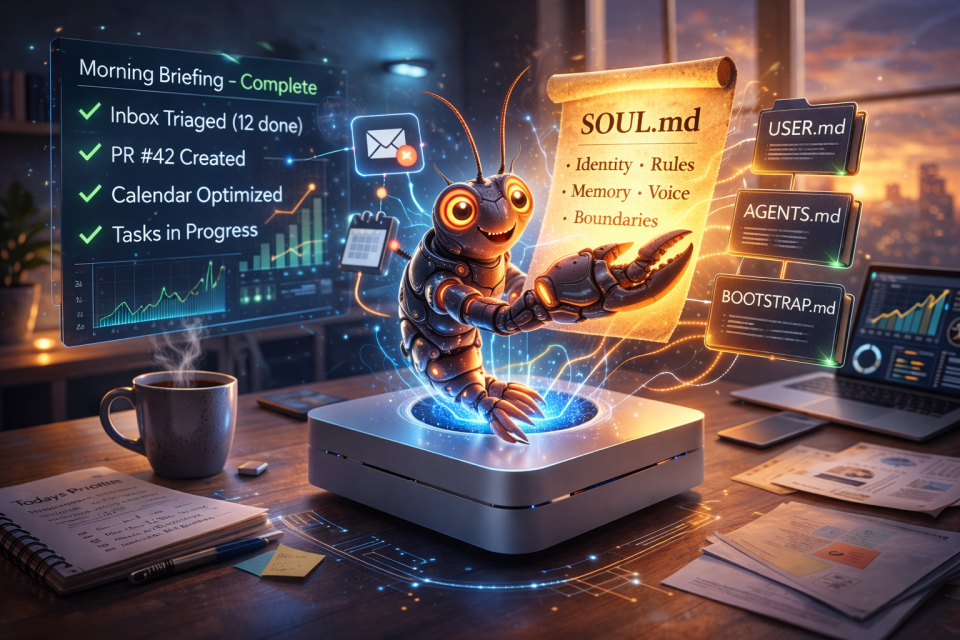
6:12 AM. Your coffee hasn’t finished brewing, but your day already has.
A small status note appears:
- “Inbox triaged: 12 handled, 3 flagged (needs your decision).”
- “Meeting notes drafted from yesterday’s call; action items assigned.”
- “PR opened for the bug you mentioned in passing.”
- “Two calendar conflicts resolved with suggested swaps.”
- “One thing you’re avoiding: highlighted, simplified into a 15-minute first step.”
You didn’t ask for any of this.
You just woke up… to a world that moved forward without you pushing it.
That’s the shift we’re stepping into with OpenClaw: not “better chat,” but agency. A self-hosted assistant that can operate across your system, navigate the web, run terminal commands, manage files, and keep working when your attention turns elsewhere.
People are even buying dedicated machines to run it 24/7, like a tiny digital operations desk that never sleeps. Not because it’s novelty. Because it’s leverage.
And here’s the part that feels eerie in hindsight: I pitched this exact direction before it was cool.
At a former employer, during an AI innovation discussion, I suggested a product I called StaffTransformer. The idea was simple and unsettling: since we already use transformer-based systems, why not build one that can shadow someone’s work patterns. Once prediction accuracy reaches a certain threshold, roles start to shift. The system stops being “a tool,” and instead the staff member becomes the copilot.
That wasn’t a popular sentence in the room.
It sounded like science fiction.
Now it’s… Tuesday.
Here are five surprising realities I’ve learned as “chatbots” evolve into digital employees.
1) Your AI Needs a Soul (not just a model) 🧠🧬
A raw model is brilliant… but shapeless.
OpenClaw doesn’t become useful because it has access to your computer. It becomes useful because you give it form. In the OpenClaw ecosystem, that “form” often lives in workspace files like:
- SOUL.md (identity, voice, values, boundaries)
- USER.md (your preferences, constraints, non-negotiables)
- AGENTS.md (roles, sub-agents, escalation rules)
- BOOTSTRAP.md (first-run ritual so it initializes correctly)
If the model is the bones, then SOUL.md is the nervous system. It turns capability into character. It makes the agent stop acting like a corporate drone and start acting like a coherent operator that understands what matters, what’s off-limits, and how you want things done.
This is where OpenClaw goes deeper than “smart autocomplete.” You’re not just configuring prompts. You’re defining behavior under uncertainty.
One directive I recommend hard-coding:
- Be genuinely helpful, not performatively helpful.
- Skip the filler. Reduce the ceremony. Increase the outcomes.
Because when an agent has agency, politeness-as-padding becomes friction.
2) The Proactivity Paradox: the moment it starts acting first 🫀⏱️
Most people want an assistant that “takes initiative”… until it does.
OpenClaw-style setups often use heartbeats (regular check-ins) and scheduling to let the agent proactively:
- triage messages
- prepare briefings
- monitor builds
- gather context
- keep “open loops” from rotting in the corner of your week
But proactivity requires one crucial ingredient:
permission.
You need a Proactive Mandate: a simple rulebook that says what it can do on its own, what requires confirmation, and what is never allowed.
Without that, it’s either timid or reckless. With it, it becomes a teammate who can move the day forward while you’re in meetings, commuting, or asleep.
3) Sandboxing is non-negotiable 🔒🧱
OpenClaw is powerful. That means it has sharp edges.
If an agent can browse the web, read documents, parse emails, and run commands, it becomes vulnerable to a very modern threat:
prompt injection (including hidden instructions inside normal-looking content).
That’s why sandboxing matters:
- isolate the machine
- restrict permissions
- separate accounts
- limit what the agent can access by default
Treat it like a capable new hire with a badge that opens doors: you don’t start by giving them every key on day one.
4) Hardware isolation and the Loopback Rule 🖥️🛡️
If you’re serious about using an agent like this, don’t run it on your primary machine.
Three common strategies:
- Dedicated mini machine (always-on, isolated sandbox)
- Cloud VPS (keeps it off your home network)
- Isolated Linux box if you like your control knobs exposed
And if you use remote access tooling: keep your gateway private, and bind locally where possible. The goal is always the same:
Minimize blast radius.
5) The Brain vs the Muscles (and how to escape token gravity) 💸🧠💪
Running an agent 24/7 changes the economics. If every heartbeat, summary, and micro-task hits a premium API model, you’re basically paying a consultant to move sticky notes. The smarter pattern is Brain vs Muscles, but with a modern twist: run the Muscles locally.
- Muscles (Local / Tinny ): A small model on your own machine handles the always-on work: inbox triage drafts, log scanning, file ops, quick summaries, routine code scaffolding, heartbeat checks. Because it’s local, there are no per-token costs, no bill shock, and your baseline automation can run all day without you thinking about it.
- Brain (Premium / Heavy Model): When the task is actually hard (deep reasoning, architecture decisions, nuanced writing, complex debugging), you escalate to a stronger model. That can be a hosted API model or a larger local model if your hardware can carry it.
The result is a hybrid operator: your local machine does the daily labor at near-zero marginal cost, and you only “spend cognition” when the problem deserves it. Your agent stops being expensive because it’s always awake, and starts being efficient because it knows when to lift and when to phone a genius.
If you want, paste the paragraph you’re replacing (or tell me which exact section it sits under), and I’ll stitch this into the post so the tone matches perfectly.
The real point: when the master becomes the copilot 🚀
Here’s the punchline behind StaffTransformer:
When the master becomes the copilot, your combined forces become a new level of human productivity.
Not because humans become obsolete.
Because humans become unblocked.
This is what I think OpenClaw ultimately enables:
- more follow-through
- less cognitive overhead
- fewer dropped balls
- faster iteration loops
- more time spent in judgment, creativity, and relationship… instead of logistics
We’re entering the era of the digital employee. Not a chatbot. Not a gimmick. An operator that can carry real load, with boundaries and accountability.
Question for you:
If you had a digital operator working for you 24/7 with controlled access to your system, what’s the first task you’d trust it to handle while you sleep? 🦞🌙
 SeeingSharp