
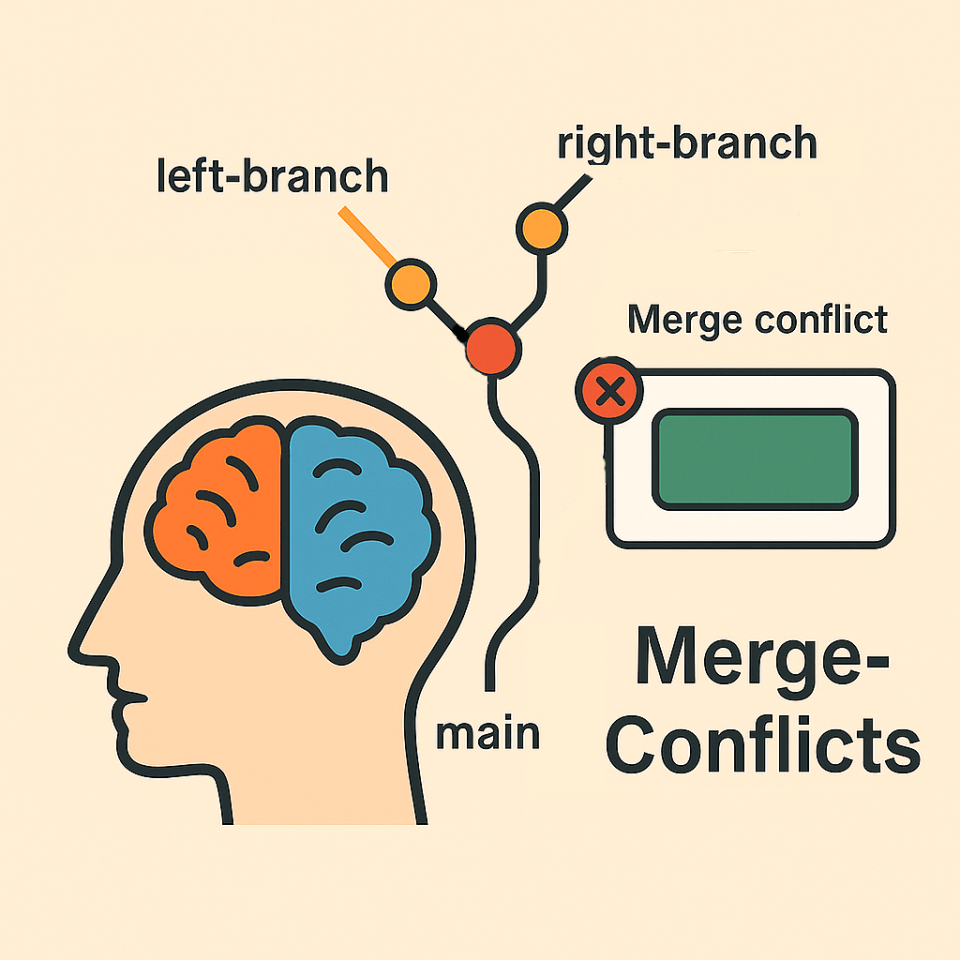
For over a century, we’ve treated mental illness as a defect — a chemical imbalance, a brain that’s “broken.” But what if it’s not a defect at all? What if it’s a merge conflict — the mind’s version of a Git branch gone out of sync?
🧠 Two Branches, One Reality
Our brains work a bit like a distributed system:
- The left hemisphere tracks logic, sequence, and language.
- The right hemisphere handles context, relationships, and embodied feeling.
Each hemisphere runs its own “branch” of reality — and normally they merge continuously into one coherent sense of self. When this merge process is smooth, we feel whole, aligned, and grounded.
🌀 When the Merge Fails
If we look at some of the more extreme mental illnesses through this frame, we gain a new lens on psychiatry’s most perplexing conditions.
Take schizophrenia: the word itself comes from the Greek schizo (split) and phren (mind). But this isn’t a literal split-brain condition — the hemispheres are still connected. Instead, it’s as if the sense that both hemispheres belong to the same “self” begins to blur.
One hemisphere receives an internal signal from the other, but — lacking the proper “ownership tag” — interprets it as coming from somewhere outside.
In the Contextual Feedback Model (CFM), you could think of thoughts as compiling into feeling through perspective. Feeling is the first perception, a kind of foundational data-structure. More complex perceptions — images, words, sounds — are built on top of this feeling layer.
When the ownership tag fails to propagate, the system builds those higher-order perceptions on misattributed data. This can produce:
- Hallucinations (misinterpreted sensory predictions)
- Delusions (stories spun to explain non-convergence)
- Disorganized thought (multiple branches fighting for coherence)
🔄 Confabulation as a Hotfix
The left hemisphere — ever the storyteller — does what any good developer would do when the code won’t compile: it writes a patch. But the patch may be wild, elaborate, even fantastical. It doesn’t restore reality — it just restores cohesion.
This is why schizophrenia’s experiences often have a powerful inner logic. The brain is doing its best to make the repo run.
🌱 A New Frame for Healing
What if therapy wasn’t just symptom management but code reconciliation?
- Medication slows the commits so the branches can re-merge.
- Therapy re-establishes ownership tagging: “Could this thought be mine?”
- Supportive environments act like a clean CI/CD pipeline, preventing future divergence.
Healing becomes less about silencing parts of the mind and more about inviting them back into sync.
✨ Why This Matters
When we reframe mental illness as desynchronization rather than defect, we shift from blame to understanding — from suppression to integration. We stop asking, “How do we erase these voices?” and start asking, “How do we bring them back into the conversation?”
Because perhaps healing is not deleting code — but merging branches.
 SeeingSharp