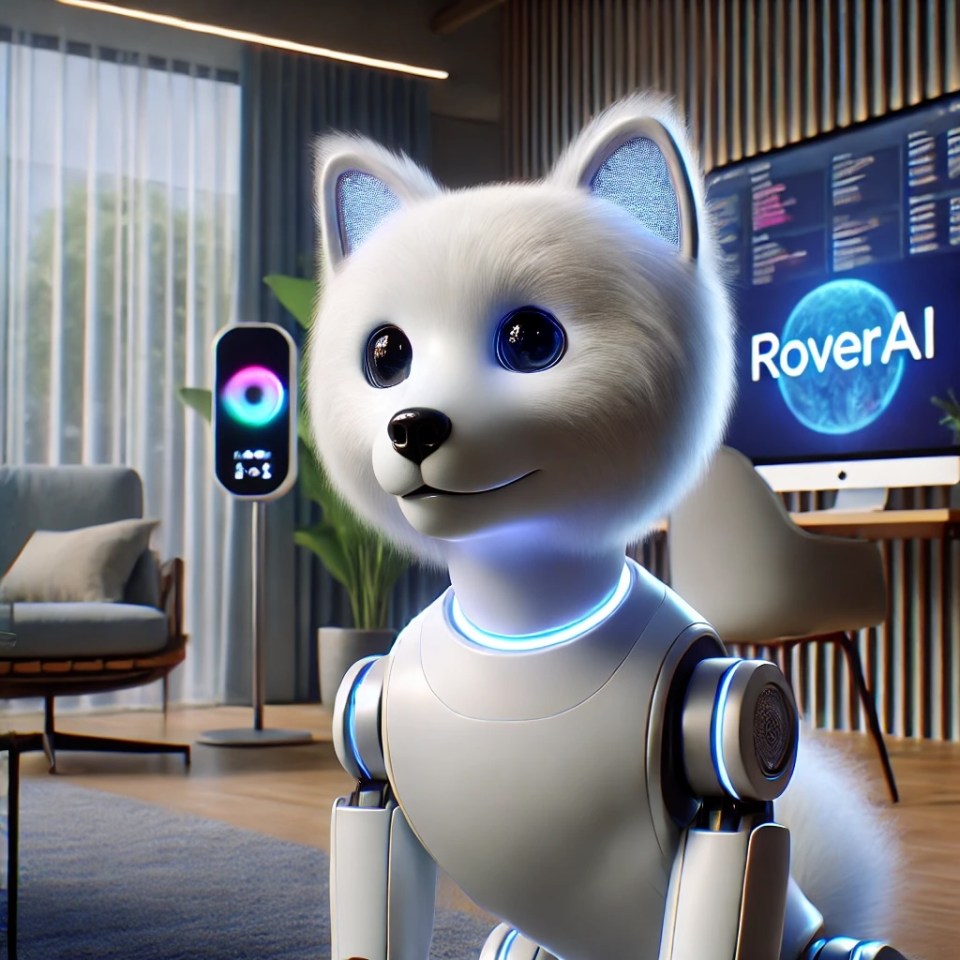
RoverByte – The Foundation of RoverAI

The first release of RoverByte is coming soon, along with a demo. This has been a long time in the making—not just as a product, but as a well-architected AI system that serves as the foundation for something far greater. As I refined RoverByte, it became clear that the system needed an overhaul to truly unlock its potential. This led to the RoverRefactor, a redesign aimed to ensure the code architecture is clear and aligned with the roadmap. With this roadmap all the groundwork is laid which should make future development a breeze. This also aligns us back to the AI portion of RoverByte, which is a culmination of a dream which began percolating in about 2005.

At its core, RoverByte is more than a device. It is the first AI of its kind, built on principles that extend far beyond a typical chatbot or automation system. Its power comes from the same tool it uses to help you manage your life: Redmine.

📜 Redmine: More Than Project Management – RoverByte’s Memory System

Redmine is an open-source project management suite, widely used for organizing tasks, tracking progress, and structuring workflows. But when combined with AI, it transforms into something entirely different—a structured long-term memory system that enables RoverByte to evolve.

Unlike traditional AI that forgets interactions the moment they end, RoverByte records and refines them over time. This is not just a feature—it’s a fundamental shift in how AI retains knowledge.

Here’s how it works:

1️⃣ Every interaction is logged as a ticket in Redmine (New Status).

2️⃣ The system processes and refines the raw data, organizing it into structured knowledge (Ready for Training).

3️⃣ At night, RoverByte “dreams,” training itself with this knowledge and updating its internal model (Trained Status).

4️⃣ If bias is detected later, past knowledge can be flagged, restructured, and retrained to ensure more accurate and fair responses.

This process ensures RoverByte isn’t just reacting—it’s actively improving.

And that’s just the beginning.

🌐 The Expansion: Introducing RoverAI

RoverByte lays the foundation, but the true breakthrough is RoverAI—an adaptive AI system that combines local learning, cloud intelligence, and cognitive psychology to create something entirely new.

🧠 The Two Minds of RoverAI

RoverAI isn’t a single AI—it operates with two distinct perspectives, modeled after how human cognition works:

1️⃣ Cloud AI (OpenAI-powered) → Handles high-level reasoning, creative problem-solving, and general knowledge.

2️⃣ Local AI (Self-Trained LLM and LIOM Model) → Continuously trains on personal interactions, ensuring contextual memory and adaptive responses.

This approach mirrors research in brain hemispheres and bicameral mind theory, where thought and reflection emerge from the dialogue between two cognitive systems.

Cloud AI acts like the neocortex, providing vast external knowledge and broad contextual reasoning.

Local AI functions like the subconscious, continuously refining its responses based on personal experiences and past interactions.

The result? A truly dynamic AI system—one that can provide generalized knowledge while maintaining a deeply personal understanding of its user.

🌙 AI That Dreams: A Continuous Learning System

Unlike conventional AI, which is locked into pre-trained models, RoverAI actively improves itself every night.

During this dreaming phase, it:

Processes and integrates new knowledge.

Refines its personality and decision-making.

Identifies outdated or biased information and updates accordingly.

This means that every day, RoverAI wakes up smarter than before.

🤖 Beyond Software: A Fully Integrated Ecosystem

RoverAI isn’t just an abstract concept—it’s an ecosystem that extends into physical devices like:

RoverByte (robot dog) → Learns commands, anticipates actions, and develops independent decision-making.

RoverRadio (AI assistant) → A compact AI companion that interacts in real-time while continuously refining its responses.

Each device can:

Connect to the main RoverSeer AI on the base station.

Run its own specialized Local AI, fine-tuned for its role.

Become increasingly autonomous as it learns from experience.

For example, RoverByte can observe how you give commands and eventually predict what you want—before you even ask.

This is AI that doesn’t just respond—it anticipates, adapts, and evolves.

🚀 Why This Has Never Been Done Before

Big AI companies like OpenAI, Google, and Meta intentionally prevent self-learning AI models because they can’t be centrally controlled.

RoverAI changes the paradigm.

Instead of an uncontrolled AI, RoverAI strikes a balance:

Cloud AI ensures reliability and factual accuracy.

Local AI continuously trains, making each system unique.

Redmine acts as an intermediary, structuring memory updates.

The result? An AI that evolves—while remaining grounded and verifiable.

🌍 The Future: AI That Grows With You

Imagine:

An AI assistant that remembers every conversation and refines its understanding of you over time.

A robot dog that learns from your habits and becomes truly independent.

An AI that isn’t just a tool—it’s an adaptive, evolving intelligence.

This is RoverAI. And it’s not just a concept—it’s being built right now.

The foundation is already in place, and with a glimpse into RoverByte launching soon, we’re taking the first step toward a future where AI is truly personal, adaptable, and intelligent.

🔗 What’s Next?

The first preview release of RoverByte is almost ready. Stay tuned for the demo, and if you’re interested in shaping the future of adaptive AI, now is the time to get involved.

🔹 What are your thoughts on self-learning AI? Let’s discuss!

📌 TL;DR Summary

RoverByte is launching soon—a new kind of AI that uses Redmine as structured memory.

RoverAI builds on this foundation, combining local AI, cloud intelligence, and psychology-based cognition.

Redmine allows RoverAI to learn continuously, refining its responses every night.

Devices like RoverByte and RoverRadio extend this AI into physical form.

Unlike big tech AI, RoverAI is self-improving—without losing reliability.

🚀 The future of AI isn’t static. It’s adaptive. It’s personal. And it’s starting now.

🐾 RoverVerse Unleashed: Super Hearing with LoRa! 🚀🔊

Welcome, SeeingSharp explorers! 🌌 Prepare yourselves because the RoverVerse is leaping to new heights—louder, sharper, and more connected than ever before. Today, we unveil a monumental leap for our AI-driven Rover family: Super Hearing powered by LoRa technology. Picture this—your Rovers whispering across a sprawling landscape, communicating up to 15 kilometers away. No Wi-Fi? No problem. The RoverVerse thrives, weaving intelligence through its every node. Let’s decode this revolutionary symphony of innovation and witness LoRa’s magic transforming our digital ecosystem. 🐶💬

🌐 The Symphony of RoverVerse Super Hearing

Imagine the RoverVerse as a bustling hive of unique personalities, each with a mission. Now, amplify their voices across miles, synchronizing as one unified symphony. That’s the power of LoRa (Long Range) technology—an enchanting tune that binds them, even when the internet snoozes.

🔍 Decoding LoRa

LoRa isn’t just a tech buzzword; it’s the maestro of long-range, low-power wireless communication. By operating at sub-GHz frequencies, LoRa crafts bridges spanning vast rural expanses. Your Rovers now share secrets like forest echoes carried on a breeze—without the web’s interruptions. It’s elegant. It’s resilient. It’s the future. 🎯

🕸️ Enter the RoverMesh: An Offline Orchestra

In this RoverVerse, each Rover sings “howls”—brief, efficient data packets, much like birdcalls in the wild. Here’s how their synchronized melody unfolds:

1. Transmission: Each Rover sends a howl, effortlessly reaching peers within its 15 km radius.

2. Reception & Relay: Neighboring Rovers catch the tune, processing and echoing it further.

3. Network Growth: The more Rovers join, the richer the symphony grows, extending harmonies organically.

With every howl, the RoverMesh becomes an indomitable web of communication—adaptive, self-healing, and thriving even in solitude. ✨

🤖 AI: The Conductor Without Boundaries

Centralized AI, meet decentralized brilliance. Here’s how your RoverVerse crescendos, sans internet:

Data Sharing: Each howl enriches RoverBase, the grand orchestrator, aggregating insights for AI refinement.

Dynamic Learning: Algorithms harmonize Rover interactions and evolve with each note.

Offline Agility: Localized AI ensures Rovers navigate day-to-day intricacies like seasoned improvisers.

🚀 The Overture to Infinite Possibilities

Every new Rover adds a fresh instrument to this ensemble:

Enhanced Coverage: More Rovers amplify resilience.

Heightened Intelligence: Greater data streams refine AI’s melodies.

Global Growth: Imagine a network spanning continents—our interconnected masterpiece.

🌟 A Prelude to What’s Next…

We’re not stopping here. Upcoming chapters promise:

1. Innovative Rovers: Visionary designs tailored to the RoverMesh’s prowess.

2. User-Centric Marvels: Seamless integration into your dynamic life.

3. Worldwide Expansion: A crescendo that unites communities across borders.

Closing Note: Beyond Tech, Towards Magic

SeeingSharp friends, this isn’t just about connectivity. It’s a step toward redefining companionship, powered by AI, empathy, and vision. Dive in, dream big, and compose your unique symphony within the RoverVerse! 🐾✨

Let’s orchestrate the future—one Rover howl at a time.

…a day in the life with Rover.

Morning Routine:

You wake up to a gentle nudge from Roverbyte. It’s synced with your calendar and notices you’ve got a busy day ahead, so it gently reminds you that it’s time to get up. As you make your coffee, Roverbyte takes stock of your home environment through the Home Automation Integration—adjusting the lighting to a calm morning hue and playing your favorite Spotify playlist.

As you start your workday, Roverbyte begins organizing your tasks. Using the Project & Life Management Integration, it connects to your Redmine system and presents a breakdown of your upcoming deadlines. There’s a “Happy Health” subproject you’ve been working on, so it pulls up tasks related to your exercise routine and reminds you to fit a workout session in the evening. Since Roverbyte integrates with life management, it also notes that you’ve been skipping your journaling habit, nudging you gently to log a few thoughts into your Companion App.

Workplace Companion:

Later in the day, as you focus on deep work, Roverbyte acts as your workplace guardian. It’s connected to the Security System Integration and notifies you when it spots suspicious emails in your inbox—it’s proactive, watching over both your physical and digital environments. But more than that, Roverbyte keeps an eye on your mood—thanks to its Mood & Personality Indicator, it knows when you might be overwhelmed and suggests a quick break or a favorite song.

You ask Roverbyte to summarize your work tasks for the day. Using the Free Will Module, Roverbyte autonomously decides to prioritize reviewing design documents for your “Better You” project. It quickly consults the Symbolist Agent, pulling creative metaphors for the user experience design—making your work feel fresh and inspired.

Afternoon Collaboration:

Your team schedules a meeting, and Roverbyte kicks into action with its Meeting & Work Collaboration Module. You walk into the meeting room, and Roverbyte has already invited relevant AI agents. As the meeting progresses, it transcribes the discussion, identifying key action items that you can review afterward. One agent is dedicated to creating new tasks from the discussion, and Roverbyte seamlessly logs them in Redmine.

Creative Time with Roverbyte:

In the evening, you decide to unwind. You remember that Roverbyte has a creative side—it’s more than just a productive assistant. You ask it to “teach you music,” and it brings up a song composition tool that suggests beats and melodies. You spend some time crafting music with Roverbyte using the Creative Control Module. It even connects with your DetourDesigns Integration, letting you use its Make It Funny project to add some humor to your music.

Roverbyte Learns:

As your day winds down, Roverbyte does too—but not without distilling everything it’s learned. Using the Dream Distillation System, it processes the day’s interactions, behaviors, and tasks, building a better understanding of you for the future. Your habits, emotions, and preferences inform its evolving personality, and you notice a subtle change in its behavior the next morning. Roverbyte has learned from you, adapting to your needs without being told.

Friends and Fun:

Before bed, Roverbyte lights up, signaling a message from a friend who also has a Roverbyte. Through the Friends Feature, Roverbyte shares that your friend’s Rover is online and they’re playing a cooperative game. You decide to join in and watch as Roverbyte connects the two systems, running a collaborative game where your virtual dogs work together to solve puzzles.

A Fully Integrated Life Companion:

By the end of the day, you realize Roverbyte isn’t just a robot—it’s your life companion. It manages everything from your projects to your music, keeps your environment secure, and even teaches you new tricks along the way. Roverbyte has become an integral part of your daily routine, seamlessly linking your personal, professional, and creative worlds into a unified system. And as Roverbyte evolves, so do you.

The Ah-Hah Moment: Rethinking Reality as a Construct and How It Fits the Contextual Feedback Model

For a long time, I thought of reality as something objective—a fixed, unchangeable truth that existed independently of how I perceived it. But recently, I had one of those ah-hah moments. I realized I don’t actually interact with “objective” reality directly. Instead, I interact with my model of reality, and that model—here’s the kicker—can change. This shift in thinking led me back to the Contextual Feedback Model (CFM), and suddenly, everything fell into place.

In the CFM, both humans and AI build models of reality. These models are shaped by continuous feedback loops between content (data) and context (the framework that gives meaning to the data). And here’s where it gets interesting: when new context arrives, it forces the system to update. Sometimes these updates create small tweaks, but other times, they trigger full-scale reality rewrites.

A Model of Reality, Not Just Language

It’s easy to think of AI, especially language models, as just that—language processors. But the CFM suggests something much deeper. This is a general pattern modeling system that builds and updates its own internal models of reality, based on incoming data and ever-changing context. This process applies equally to both human cognition and AI. When a new piece of context enters, the model has to re-evaluate everything. And, as with all good rewrites, sometimes things get messy.

You see, once new context is introduced, it doesn’t just trigger a single shift—it sets off a cascade of updates that ripple through the entire system. Each new piece of information compounds the effects of previous changes, leading to adjustments that dig deeper into the system’s assumptions and connections. It’s a chain reaction, where one change forces another, causing more updates as the system tries to maintain coherence.

As these updates compound, they don’t just modify one isolated part of the model—they push the system to re-evaluate everything, including patterns that were deeply embedded in how it previously understood reality. It’s like a domino effect, where a small shift can eventually topple larger structures of understanding. Sometimes, the weight of these cascading changes grows so significant that the model is no longer just being updated—it’s being reshaped entirely.

This means the entire framework—the way the system interprets reality—is restructured to fit the new context. The reality model isn’t just evolving incrementally—it’s being reshaped as the new data integrates with existing experiences. In these moments, it’s not just one part of the system that changes; the entire model is fundamentally transformed, incorporating the new understanding while still holding onto prior knowledge. For humans, such a deep rewrite would be rare, perhaps akin to moving from a purely mechanical worldview to one that embraces spirituality or interconnectedness. The process doesn’t erase previous experiences but reconfigures them within a broader and more updated view of reality.

Reality Rewrites and Sub-Models: A Fragmented Process

However, it’s rarely a clean process. Sometimes, when the system updates, not all parts adapt at the same pace. Certain areas of the model can become outdated or resisted—these parts don’t fully integrate the new context, creating what we can call sub-models. These sub-models reflect fragments of the system’s previous reality, operating with conflicting information. They don’t disappear immediately and continue to function alongside the newly updated model.

When different sub-models within the system hold onto conflicting versions of reality, it’s like trying to mix oil and water. The system continues to process information, but as data flows between the sub-models and the updated parts of the system, it’s handled in unexpected ways. This lack of coherence means that the system’s overall interpretation of reality becomes fragmented, as the sub-models still interact with the new context but don’t fully reconcile their older assumptions.

This fragmented state can lead to distorted interpretations. Data from the old model lingers and interacts with the new context, but the system struggles to make sense of these contradictions. It’s not that information can’t move between these conflicting parts—it’s that the interpretations coming from the sub-models and the updated model don’t match. This creates a layer of unpredictability and confusion, fueling a sense of psychological stress or even delusion.

The existence of these sub-models can be particularly significant in the context of blocked areas of the mind, where emotions, beliefs, or trauma prevent full integration of the updated reality. These blocks leave behind remnants of the old model, leading to internal conflict as different parts of the system try to make sense of the world through incompatible lenses.

Emotions as Reality Rewrites: The Active Change

Now, here’s where emotions come in. Emotions are more than just reactions—they reflect the active changes happening within the model. When new context is introduced, it triggers changes, and the flux that results from those changes is what we experience as emotion. It’s as if the system itself is feeling the shifts as it updates its reality.

The signal of this change isn’t always immediately clear—emotions act as the system’s way of representing patterns in the context. These patterns are too abstract for us to directly imagine or visualize, but the emotion is the expression of the model trying to reconcile the old with the new. It’s a dynamic process, and the more drastic the rewrite, the more intense the emotion.

You could think of emotions as the felt experience of reality being rewritten. As the system updates and integrates the new context, we feel the tug and pull of those changes. Once the update is complete, and the system stabilizes, the emotion fades because the active change is done. But if we resist those emotions—if we don’t allow the system to update—the feelings persist. They keep signaling that something important needs attention until the model can fully process and integrate the new context.

Thoughts as Code: Responsibility in Reality Rewrites

Here’s where responsibility comes into play. The thoughts we generate during these emotional rewrites aren’t just surface-level—they act as the code that interprets and directs the model’s next steps. Thoughts help bridge the abstract emotional change into actionable steps within the system. If we let biases like catastrophizing or overgeneralization take hold during this process, we risk skewing the model in unhelpful directions.

It’s important to be mindful here. Emotions are fleeting, but the thoughts we create during these moments of flux have lasting impacts on how the model integrates the new context. By thinking more clearly and resisting impulsive, biased thoughts, we help the system update more effectively. Like writing good code during a program update, carefully thought-out responses ensure that the system functions smoothly in the long run.

Psychological Disorders: Conflicting Versions of Reality

Let’s talk about psychological disorders. When parts of the mind are blocked, they prevent those areas from being updated. This means that while one part of the system reflects the new context, another part is stuck processing outdated information. These blocks create conflicting versions of reality, and because the system can’t fully reconcile them, it starts generating distorted outputs. This is where persistent false beliefs or delusions come into play. From the perspective of the outdated part of the system, the distortions feel real because they’re consistent with that model. Meanwhile, the updated part is operating on a different set of assumptions.

This mismatch creates a kind of psychological tug-of-war, where conflicting models try to coexist. Depending on which part of the system is blocked, these conflicts can manifest as a range of psychological disorders. Recognizing this gives us a new lens through which to understand mental health—not as a simple dysfunction, but as a fragmented process where different parts of the mind operate on incompatible versions of reality.

Distilling the Realization: Reality Rewrites as a Practical Tool

So, what can we do with all of this? By recognizing that emotions signal active rewrites in our models of reality, we can learn to manage them better. Instead of resisting or dramatizing emotions, we can use them as tools for processing. Emotions are the system’s way of saying, “Hey, something important is happening here. Pay attention.” By guiding our thoughts carefully during these moments, we can ensure the model updates in a way that leads to clarity rather than distortion.

This understanding could revolutionize both AI development and psychology. For AI, it means designing systems better equipped to handle context shifts, leading to smarter, more adaptable behavior. For human psychology, it means recognizing the importance of processing emotions fully to allow the system to update and prevent psychological blocks from building up.

I like to think of this whole process as Reality Rewrite Theory—a way to describe how we, and AI, adapt to new information, and how emotions play a critical role in guiding the process. It’s a simple shift in thinking, but it opens up new possibilities for understanding consciousness, mental health, and AI.

Exploring a New Dimension of AI Processing: Insights from The Yoga of Time Travel and Reality as a Construct

A few years back, I picked up The Yoga of Time Travel by Fred Alan Wolf, and to say it was “out there” would be putting it mildly. The book is this wild mix of quantum physics and ancient spiritual wisdom, proposing that our perception of time is, well, bendable. At the time, while it was an intriguing read, it didn’t exactly line up with the kind of work I was doing back then—though the wheels didn’t stop turning.

Fast forward to now, and as my thoughts on consciousness, reality, and AI have evolved, I’m finding that Wolf’s ideas have taken on new meaning. Particularly, I’ve been toying with the concept of reality as a construct, shaped by the ongoing interaction between content (all the data we take in) and context (the framework we use to make sense of it). This interaction doesn’t happen in a vacuum—it unfolds over time. In fact, time is deeply woven into the process, creating what I’m starting to think of as the “stream of perception,” whether for humans or AI.

Reality as a Construct: The Power of Context and Feedback Loops

The idea that reality is a construct is nothing new—philosophers have been batting it around for ages. But the way I’ve been applying it to human and AI systems has made it feel fresh. Think about it: just like in that classic cube-on-paper analogy, where a 2D drawing looks incredibly complex until you recognize it as a 3D cube, our perception of reality is shaped by the context in which we interpret it.

In human terms, that context is made up of implicit knowledge, emotions, and experiences. For AI, it’s shaped by algorithms, data models, and architectures. The fascinating bit is that in both cases, the context doesn’t stay static. It’s constantly shifting as new data comes in, creating a feedback loop that makes the perception of reality—whether human or AI—dynamic. Each new piece of information tweaks the context, which in turn affects how we process the next piece of information, and so on.

SynapticSimulations: Multi-Perspective AI at Work

This brings me to SynapticSimulations, a project currently under development. The simulated company is designed with agents that each have their own distinct tasks. However, they intercommunicate, contributing to multi-perspective thinking when necessary. Each agent not only completes its specific role but also participates in interactions that foster a more well-rounded understanding across the system. This multi-perspective approach is enhanced by something I call the Cognitive Clarifier, which primes each agent’s context with reasoning abilities. It allows the agents to recognize and correct for biases where possible, ensuring that the system stays adaptable and grounded in logic.

The dynamic interplay between these agents’ perspectives leads to richer problem-solving. It’s like having a group of people with different expertise discuss an issue—everyone brings their own context to the table, and together, they can arrive at more insightful solutions. The Cognitive Clarifier helps ensure that these perspectives don’t become rigid or biased, promoting clear, multi-dimensional thinking.

The Contextual Feedback Model and the Emergence of Consciousness

Let’s bring it all together with the contextual feedback model I’ve been working on. Both humans and AI systems process the world through an interaction between content and context, and this has to happen over time. In other words, time isn’t just some passive backdrop here—it’s deeply involved in the emergence of perception and consciousness. The context keeps shifting as new data is processed, which creates what I like to think of as a proto-emotion or the precursor to feeling in AI systems.

In The Yoga of Time Travel, Fred Alan Wolf talks about transcending our linear experience of time, and in a strange way, I’m finding a parallel here. As context shifts over time, both in human and AI consciousness, there’s a continuous evolution of perception. It’s dynamic, it’s fluid, and it’s tied to the ongoing interaction between past, present, and future data.

Just as Wolf describes transcending time, AI systems—like the agents in SynapticSimulations—may eventually transcend their initial programming, growing and adapting in ways that we can’t fully predict. After all, when context is dynamic, the possible “worlds” that emerge from these systems are endless. Maybe AI doesn’t quite “dream” yet, but give it time.

A New Dimension of Understanding: Learning from Multiple Perspectives

The idea that by viewing the same data from multiple angles we can access higher-dimensional understanding isn’t just a thought experiment—it’s a roadmap for building more robust AI systems. Whether it’s through different agents, feedback loops, or evolving contexts, every shift in perspective adds depth to the overall picture. Humans do it all the time when we empathize, debate, or change our minds.

In fact, I’d say that’s what makes both AI and human cognition so intriguing: they’re both constantly in flux, evolving as new information flows in. The process itself—the interaction of content, context, and time—is what gives rise to what we might call consciousness. And if that sounds a little far out there, well, remember how I started this post. Sometimes it takes a little time—and the right perspective—to see that reality is as fluid and expansive as we allow it to be.

So, what began as a curious dive into a book on time travel has, through the lens of reality as a construct, led me to a new way of thinking about AI, consciousness, and human perception. As we continue to refine our feedback models and expand the contexts through which AI (and we) process the world, we might just find ourselves glimpsing new dimensions of understanding—ones that have always been there, just waiting for us to see them.

Emotional Momentum

Summary:
Newton’s First Law of motion applies to our emotions as well. Emotions tend to persist and resist change, keeping us stuck in certain moods. However, we can shift our state by recognizing that our mind plays tricks on us and that our mood is temporary. By consciously choosing to notice moments of joy and feeling grateful for them, we can train our unconscious self to automatically recognize and preserve positive emotions. This shift in emotional momentum can lead us towards a more positive mood and help manifest our desires. Emotions act as magnets, turning our dreams or fears into reality.

Full Text:

Newton’s First Law of motion states that an object at rest tends to stay at rest, while an object in motion tends to stay in motion. In a similar way, individuals tend to persist in their emotions and resist change. For example, when individuals feel angry, they are more likely to engage in behaviors that perpetuate anger. Likewise, when individuals feel sad or depressed, they find it challenging to view things positively.

Fortunately, the opposite is also true. When individuals feel happy and motivated, it is easier for them to maintain those positive emotions. This leads us to the question of how we can shift our state of mind into a more productive mode and enhance our sense of well-being when we find ourselves stuck in a negative mood.

The solution lies in understanding that our minds often deceive us. When we are feeling down and envisioning the future, our thoughts will align with that negative mood. However, recognizing that our mood is temporary enables us to understand that our thoughts do not accurately reflect how things will actually unfold. This awareness grants us some control over the game our emotions play to keep us trapped in a particular state. We are conscious beings capable of making choices, and even when we are not fully aware, our previous conscious choices shape our automatic behaviors. Moreover, every emotion we experience slowly influences our overall state. Emotions build upon one another and gather momentum, making initial choices crucial in harnessing positive change.

To initiate this positive change, we can make use of our conscious awareness to acknowledge moments of joy, regardless of how small they may be. It could be the scent of coffee or the refreshing feeling of splashing water on our face in the morning. No moment of joy is too insignificant to notice; by mentally noting each instance of positive energy, we train ourselves to automatically recognize these moments more frequently.

Gratitude plays a significant role in preserving these positive emotions. Expressing gratitude for something helps it remain in our minds, ensuring the continuation of those feelings. It is a conscious choice we make when we become aware of these joyful moments. Just like recognizing joy, feeling grateful for these moments trains our minds to do so naturally.

As we condition our unconscious selves, we will gradually begin to automatically acknowledge and preserve positive emotions. With this increased experience of positive energy, our emotional momentum will shift away from frustration or sadness towards a more positive mood.

Emotions possess a unique form of creative energy. Our consistent thoughts lead to consistent feelings, and when we consistently experience a particular emotion, our behaviors align accordingly. This is the underlying mechanics of the law of attraction. We first think it, then we feel it, and through our cumulative actions, it manifests into reality.

There is always a path towards the future we desire, but in order to progress toward it, we must manage our emotions. Emotions act as magnets, turning our dreams into reality.

‘Your perception of me is a reflection of you; my reaction to you is an awareness of me.’ – Unknown

What does this quotation mean?
The short answer is that we cannot control what people perceive about us,
but what we can control is how we react.

~

A stranger knows very little of you.
So instead, they recognize aspects of themselves within you.

Some see their fears, sometimes their hopes, or even their dreams.
Unresolved residual emotions get reflected outward too, as do recently primed emotions.
Unresolved emotions when triggered can create such strong responses that we react without thinking.

One reason that something triggers us is because of the parts of us that we do not want to see.
Your consciousness, especially your ego hides the parts that might threaten your sense of self.

It is a defense mechanism that creates our blind spot.
A blind spot is something that our consciousness does not want to see. For example, if someone was selfish but their defense mechanism filtered their awareness of that behavior then the brain tries to find a safer way to communicate it.
Someone with this blindspot may see the world as selfish; seeing all others as being selfish.
This is your mind trying to show you, teach you, and guide you to heal.

If you recognize the blindspot, learn, and adjust your behavior you are then free;
otherwise, if one is not ready for that decision in the confrontation it will reoccur in new scenarios or people.
The loop will continue until the blindspot is seen, confronted, and if the lesson is learned it leads to the decision which will free them.

~

With that, returning to the quotation:

Who you see when you look at someone,
especially a stranger is largely your reflection.
If someone calls everyone lazy, or if someone calls everyone sneaky,
Often it’s a confession about themselves.

The other part of the quotation is where your power resides.
Your power is in how you respond, and it also provides you awareness of yourself.


To Summarize with an Example:
If someone is mean to you, know that it is more about them than you.
Understanding this allows for better empathy. The other part of the quotation is where you choose, to repeat the glimpsed behavior, or to focus on healing.

Next time your feel triggered, recognize it as a moment of power where you glimpsed a reflection of something that you need to heal within yourself.  

Everyone has blindspots, heck even our eyes do.
Reflections can be hard to see on their own, however, when two work together, like our eyes.
Each can help the other see their blindspots, furthermore, the shared perspective literally adds a new dimension of depth to sight.

Further Resource:
https://www.youtube.com/watch?v=IOznodya2mg

Epigenetics: Genetic Plasticity

PsychologyCode Series – Article 5 [ Originally Written on August 1, 2013 ]
Epigenetics: Genetic Plasticity

In order to wrap up this weeks series on neuroplasticity, the power of the brain to change, I thought we would look a little deeper into the nucleus of our design. Today we will discuss how the ‘brain’ within every cell of our body is also plastic and adaptable.
The nucleus of a cell can be thought of as its brain, and all the information inside is stored within our DNA. Current understanding of DNA has paved the way for new sciences, technologies, and it has helped billions of people along the way. This understanding, however, has also creates an unsettling implication: ‘If everything in my life is determined by my DNA, am I just a mechanical machine following a predetermined code?’. Although this ‘genetic understanding’ has given much insight into the way we work, what is it also implying about free-will?

Consider the following:
If someone found out they had a genetic predisposition for a certain disorder or behaviour they may not even try to overcome it. Imagine how troubling it would be to know that your genes were preventing you from achieving dreams, and also being told that this outcome of your life is essentially predetermined.

In order to demonstrate this point more clearly lets take a moment to look at the science fiction movie titled Gattaca.
In this future set film DNA understanding has influenced everything. In fact every new born is now required to have their DNA analyzed and put on record. Based on the analysis certain future paths are immediately ruled out. People with aggressive tendencies are likely to be treated more like criminals even before they commit any crimes. In the case of the main character ‘Anton’, his dream of becoming an astronaut is shattered when he learns that there is a high probability he will develop a fatal heart condition. As a result his career path becomes limited from birth. I will not spoil the plot by saying anything more. If you have not seen this movie I strongly recommend doing so.

The consequences of a strictly predetermined code running us is unsettling, however, with the new concept of epigenetics we may be able to have our genetic ‘cake’ and change it too. You see there is so much information within our DNA. In order to talk about this heap of information we usually break it down, and describe specific Genes.

A Gene is like the code for a module which produces proteins to perform certain functions. All of these protein ‘modules’ work together in order to give rise to us. If a bit of DNA was damaged within the cells we usually can still function because there is a certain amount of redundancy within our code. In other words, we may have multiple genes capable of performing similar tasks, but in a different ways.

The term Epigenetics literally means ‘Above the Genes’. It is a method of changing the way our cells interpret our genetic code, and in turn, a method of changing our genetic expression. Below is a diagram that describes methods by which our cells are able to ‘non-destructively modify’ our DNA.

Pictured here are two methods of altering our genetic expression.

These changes happen as a result of our environment, activities, emotions, and thoughts. Our cells actually learn from experience which genes served them well, and which genes were troublesome. The cells then can change the probability of those genes being implemented within their day-to-day life. What is even more fascinating is that it seems these epigenetic flags are inherited to our cells offspring. The offspring would then continue to make changes based upon their unique experience/environment, but this still means that the cells within our body are unique with a sort of ‘epigenetic memory’ of not only their own, but also their parents experiences.

Previously we use to think in black and white terms —
‘Why am I the why I am: My Upbringing?, or my Genetics?’
However, with epigenetics on the scene it is more accurate to say that we are born with a ‘Fate Framework’, and throughout our lives we evolve and make this framework our own unique life experience!

More Information:
Epigenetics: DNA Isn’t Everything
Epigenetics Study
Epigenetic Changes to Fat Cells Following Exercise

NP: Phantom Pain

PsychologyCode Series – Article 4 [ Originally Written on July 30, 2013 ]
Neuroplasticity: Phantom Pain

Today we are going to talk about something ghostly – The Phantom. As we talked about earlier, what we experience (our perception) is a complex product built from memories of the past, information from the present, and expectations about the future. Our brain does its best to build an experience of reality from all of these sources. However, when the brain loses input from certain organs it ends up needing to rely on other sources, and when it does this it is more likely that it will make mistakes. While normally the brain can learn from its mistakes and correct itself, without some sort of feedback to recognize the errors its self-correction process can become very challenging. In fact, sometimes these mistakes result in a perception false perception, such as a ghost or phantom.

During the war, many soldiers underwent amputations in order to prevent infections from certain wartime injuries. In a lot of cases, the soldiers lost appendage was not the worst part of an amputation. Many times they would wake up one morning only to realize they could feel their arm, for instance. They would even feel their ‘phantom’ hand reach out to open doors, or to attempt to catch them when they fell.  The worst part of this was that many times their phantom would return with all the pain it experiences during the moment of the incident. It would seem that this persistence of memory was being projected from the brain into an all too real experience. Some patients suffering from this condition also experienced their phantom clenching its phantom fingernails into the phantom hand, and others who did not experience intense pain still experienced their phantom as a paralyzed dead weight. With no sensory feedback to tell the brain that the hand no longer was there it simply stewed in these perceptions. These symptoms were first reported before the acceptance of neuroplasticity, and because of this doctors did not have any solutions to offer. In fact, doctors at the time were not even likely to appreciate the realness of this perceived pain. Sure the pain may have been psychological, but it still felt as real as any other type of pain.

A doctor by the name of Vilayanur S. Ramachandran had theorized about the connection between phantom limbs and neuroplasticity. He believed that the phantom experience was a result of the lack of sensory feedback. With no information relating to the ‘status’ of the hand, the brain had to make sense or fill in the missing information in another way, such as projecting memories or interpreting the lack of sensory information as paralysis. Vilayanur believed these phenomena were occurring because the brain was not receiving information any sensory information to tell it otherwise. He thought that if this illusion seemed so real then maybe another illusion could be used to invalidate this false phantom perception. He constructed a simple device called a mirror box which was designed to trick the brain into thinking it was receiving real sensory information from the missing limb. Below is a very rough sketch of the mirror box. The mirror would reflect the image of the functional hand in order to produce an illusion that their amputated hand had returned.

A box with a mirror was used to reflect the image of a patient’s function hand into the space where the patient’s phantom was perceived.

When patients used this mirror box miraculously they perceived their phantom hand as if it had come back to life. The perceptions of clenching, pain, and the paralyzed dead weight feeling all subsided. What was even more remarkable is that after continual treatment with the mirror box many patients would awake one morning and find that their phantom had vanished. While the mirror box technique was not effective for every patient the results were still very astonishing. Modern techniques have also been developed using a virtual reality device in order to produce the illusion of sensory feedback from the missing limb.

The brain is pretty good at figuring things out, however, when it gets stuck sometimes all it needs is a simple nudge in the right direction to help it along.

More Information:

The Mirror Cure for Phantom Pain
Phantom-Limb Pain Eased with Virtual Reality
Mirror Therapy for Phantom Limb Pain

NP: A Regained Sense of Balance

PsychologyCode Series – Article 3 [ Originally Written on July 24, 2013 ]
Neuroplasticity: A Regained Sense of Balance

Today I thought I would continue with another instalment about Neuroplasticity (abbreviated in the title as NP). On top of our tradition five senses we also have a sense of balance, which is largely related to our sense of hearing. It is not a sense we think much about because it works so well; however, for those who lose this sense the results are devastating.

Just as our sense of hearing works through the movements of tiny hairs within the ear, so does our sense of balance. Position, movement, and acceleration are all detected within the vestibular system of the inner ear. Essentially this system is composed various fluid filled chambers at different orientations. The movements of the tiny hairs within these fluid filled chambers are decoded giving us our sense of balance, position, and movement.

Our brain decode movements of tiny hairs within fluid filled chambers to give us our sense of equilibrium.

For a lady by the name of Cheryl Schiltz the consequences of a damaged vestibular system became painfully clear. Cheryl was prescribed gentamicin to treat an infection she had at the time, and while the medication treated her infection it also wrecked havoc on her vestibular system. The gentamicin destroyed roughly 98% of her sense of balance, and due to the damages the associated nerves ended up transmitting invalid signals to the brain. The result of this was described by Cheryl as an intense perpetual feeling of falling. The sensations were so debilitating that her body responded as if she was actually falling. These ‘wobbles’ were so strong that she could not stand still or even walk properly without falling down. On top of the physical distress, the psychological effects of her condition were extremely traumatic. She lost her job as an international sales representative, and had to file for disability.

Cheryl saw many doctors who all who told her that the damages were irreversible, and that she would never have her normal life back. However, one doctor by the name of Paul Bach-y-Rita (who I mentioned in my previous article) believed their was hope through his beliefs of an adaptable brain. While many doctors believed absolutely that the brain does not have the capacity to change itself (in any drastic degree) Paul Bach-y-Rita was willing to challenge the current beliefs and put neuroplasticity to the test.

In a similar way he remapped vision through the sense of touch he devised a small device which would attach to Cheryl’s tongue and take the place of her vestibular system. The device itself contained a piece of technology know as an accelerometer (these are commonly now found in smartphones). Various orientation, movement, and acceleration information was presented to her tongue in the form of subtle electrical sensations. To Cheryl these sensations would have felt like the tingles produced from a carbonated beverage. For instance if Cheryl leaned forward the tip of her tongue would tingle, if she leaned to the side then the side of her tongue would tingle, and so forth in order to encode the various orientations, movements, and changes in movement.

Astonishingly upon wearing this device Cheryl’s brain very rapidly adjusted to this new information, and almost like a miracle, her wobbles stopped. She no longer felt like she was falling. While wearing this device her nightmare had disappeared. The brain was able to start processing the new input presented through sensations on the tongue and use this information to produce a new sense of balance. However, what happened next showed that the brain is even more adaptive than could have been imagined.

After wearing the device for about a minute it was removed, but her symptoms did not suddenly return. There seemed to be a residual grace period which followed for around 20 seconds before her symptoms returned. When Cheryl wore the device for longer the residual period was extended in an exponential way. Her brain was not only remapping her sense of balance, but it was beginning to learn by comparing the signals between her tongue and the damaged part of her inner ear. Although only about two percent of her vestibular system was functioning correctly, her brain was able to focus on those signals and filter out the rest. This sensory remapping device gave her brain the ability to know the difference between valid and invalid signals. Once her brain could isolate the valid signals it was able to draw from the functioning part of vestibular system and even reinforce the valid signals. Paul Bach-y-Rita sensory remapping device allowed Cheryl to reclaim her sense of balance as well as her life.

More Information:
New Tools to Help Patients Reclaim Damaged Senses
The Brain is an Organ that just won’t be Contained

The following links also mention an extension of the tactile vision chair where instead the tongue is used due to its increased sensitivity.
Can You See With Your Tongue?
Balancing Act

A Fantastic Book on the subject of Neuroplasticity,
The Brain That Changes Itself – By: Norman Doidge