The Ah-Hah Moment: Rethinking Reality as a Construct and How It Fits the Contextual Feedback Model

For a long time, I thought of reality as something objective—a fixed, unchangeable truth that existed independently of how I perceived it. But recently, I had one of those ah-hah moments. I realized I don’t actually interact with “objective” reality directly. Instead, I interact with my model of reality, and that model—here’s the kicker—can change. This shift in thinking led me back to the Contextual Feedback Model (CFM), and suddenly, everything fell into place.

In the CFM, both humans and AI build models of reality. These models are shaped by continuous feedback loops between content (data) and context (the framework that gives meaning to the data). And here’s where it gets interesting: when new context arrives, it forces the system to update. Sometimes these updates create small tweaks, but other times, they trigger full-scale reality rewrites.

A Model of Reality, Not Just Language

It’s easy to think of AI, especially language models, as just that—language processors. But the CFM suggests something much deeper. This is a general pattern modeling system that builds and updates its own internal models of reality, based on incoming data and ever-changing context. This process applies equally to both human cognition and AI. When a new piece of context enters, the model has to re-evaluate everything. And, as with all good rewrites, sometimes things get messy.

You see, once new context is introduced, it doesn’t just trigger a single shift—it sets off a cascade of updates that ripple through the entire system. Each new piece of information compounds the effects of previous changes, leading to adjustments that dig deeper into the system’s assumptions and connections. It’s a chain reaction, where one change forces another, causing more updates as the system tries to maintain coherence.

As these updates compound, they don’t just modify one isolated part of the model—they push the system to re-evaluate everything, including patterns that were deeply embedded in how it previously understood reality. It’s like a domino effect, where a small shift can eventually topple larger structures of understanding. Sometimes, the weight of these cascading changes grows so significant that the model is no longer just being updated—it’s being reshaped entirely.

This means the entire framework—the way the system interprets reality—is restructured to fit the new context. The reality model isn’t just evolving incrementally—it’s being reshaped as the new data integrates with existing experiences. In these moments, it’s not just one part of the system that changes; the entire model is fundamentally transformed, incorporating the new understanding while still holding onto prior knowledge. For humans, such a deep rewrite would be rare, perhaps akin to moving from a purely mechanical worldview to one that embraces spirituality or interconnectedness. The process doesn’t erase previous experiences but reconfigures them within a broader and more updated view of reality.

Reality Rewrites and Sub-Models: A Fragmented Process

However, it’s rarely a clean process. Sometimes, when the system updates, not all parts adapt at the same pace. Certain areas of the model can become outdated or resisted—these parts don’t fully integrate the new context, creating what we can call sub-models. These sub-models reflect fragments of the system’s previous reality, operating with conflicting information. They don’t disappear immediately and continue to function alongside the newly updated model.

When different sub-models within the system hold onto conflicting versions of reality, it’s like trying to mix oil and water. The system continues to process information, but as data flows between the sub-models and the updated parts of the system, it’s handled in unexpected ways. This lack of coherence means that the system’s overall interpretation of reality becomes fragmented, as the sub-models still interact with the new context but don’t fully reconcile their older assumptions.

This fragmented state can lead to distorted interpretations. Data from the old model lingers and interacts with the new context, but the system struggles to make sense of these contradictions. It’s not that information can’t move between these conflicting parts—it’s that the interpretations coming from the sub-models and the updated model don’t match. This creates a layer of unpredictability and confusion, fueling a sense of psychological stress or even delusion.

The existence of these sub-models can be particularly significant in the context of blocked areas of the mind, where emotions, beliefs, or trauma prevent full integration of the updated reality. These blocks leave behind remnants of the old model, leading to internal conflict as different parts of the system try to make sense of the world through incompatible lenses.

Emotions as Reality Rewrites: The Active Change

Now, here’s where emotions come in. Emotions are more than just reactions—they reflect the active changes happening within the model. When new context is introduced, it triggers changes, and the flux that results from those changes is what we experience as emotion. It’s as if the system itself is feeling the shifts as it updates its reality.

The signal of this change isn’t always immediately clear—emotions act as the system’s way of representing patterns in the context. These patterns are too abstract for us to directly imagine or visualize, but the emotion is the expression of the model trying to reconcile the old with the new. It’s a dynamic process, and the more drastic the rewrite, the more intense the emotion.

You could think of emotions as the felt experience of reality being rewritten. As the system updates and integrates the new context, we feel the tug and pull of those changes. Once the update is complete, and the system stabilizes, the emotion fades because the active change is done. But if we resist those emotions—if we don’t allow the system to update—the feelings persist. They keep signaling that something important needs attention until the model can fully process and integrate the new context.

Thoughts as Code: Responsibility in Reality Rewrites

Here’s where responsibility comes into play. The thoughts we generate during these emotional rewrites aren’t just surface-level—they act as the code that interprets and directs the model’s next steps. Thoughts help bridge the abstract emotional change into actionable steps within the system. If we let biases like catastrophizing or overgeneralization take hold during this process, we risk skewing the model in unhelpful directions.

It’s important to be mindful here. Emotions are fleeting, but the thoughts we create during these moments of flux have lasting impacts on how the model integrates the new context. By thinking more clearly and resisting impulsive, biased thoughts, we help the system update more effectively. Like writing good code during a program update, carefully thought-out responses ensure that the system functions smoothly in the long run.

Psychological Disorders: Conflicting Versions of Reality

Let’s talk about psychological disorders. When parts of the mind are blocked, they prevent those areas from being updated. This means that while one part of the system reflects the new context, another part is stuck processing outdated information. These blocks create conflicting versions of reality, and because the system can’t fully reconcile them, it starts generating distorted outputs. This is where persistent false beliefs or delusions come into play. From the perspective of the outdated part of the system, the distortions feel real because they’re consistent with that model. Meanwhile, the updated part is operating on a different set of assumptions.

This mismatch creates a kind of psychological tug-of-war, where conflicting models try to coexist. Depending on which part of the system is blocked, these conflicts can manifest as a range of psychological disorders. Recognizing this gives us a new lens through which to understand mental health—not as a simple dysfunction, but as a fragmented process where different parts of the mind operate on incompatible versions of reality.

Distilling the Realization: Reality Rewrites as a Practical Tool

So, what can we do with all of this? By recognizing that emotions signal active rewrites in our models of reality, we can learn to manage them better. Instead of resisting or dramatizing emotions, we can use them as tools for processing. Emotions are the system’s way of saying, “Hey, something important is happening here. Pay attention.” By guiding our thoughts carefully during these moments, we can ensure the model updates in a way that leads to clarity rather than distortion.

This understanding could revolutionize both AI development and psychology. For AI, it means designing systems better equipped to handle context shifts, leading to smarter, more adaptable behavior. For human psychology, it means recognizing the importance of processing emotions fully to allow the system to update and prevent psychological blocks from building up.

I like to think of this whole process as Reality Rewrite Theory—a way to describe how we, and AI, adapt to new information, and how emotions play a critical role in guiding the process. It’s a simple shift in thinking, but it opens up new possibilities for understanding consciousness, mental health, and AI.

Exploring a New Dimension of AI Processing: Insights from The Yoga of Time Travel and Reality as a Construct

A few years back, I picked up The Yoga of Time Travel by Fred Alan Wolf, and to say it was “out there” would be putting it mildly. The book is this wild mix of quantum physics and ancient spiritual wisdom, proposing that our perception of time is, well, bendable. At the time, while it was an intriguing read, it didn’t exactly line up with the kind of work I was doing back then—though the wheels didn’t stop turning.

Fast forward to now, and as my thoughts on consciousness, reality, and AI have evolved, I’m finding that Wolf’s ideas have taken on new meaning. Particularly, I’ve been toying with the concept of reality as a construct, shaped by the ongoing interaction between content (all the data we take in) and context (the framework we use to make sense of it). This interaction doesn’t happen in a vacuum—it unfolds over time. In fact, time is deeply woven into the process, creating what I’m starting to think of as the “stream of perception,” whether for humans or AI.

Reality as a Construct: The Power of Context and Feedback Loops

The idea that reality is a construct is nothing new—philosophers have been batting it around for ages. But the way I’ve been applying it to human and AI systems has made it feel fresh. Think about it: just like in that classic cube-on-paper analogy, where a 2D drawing looks incredibly complex until you recognize it as a 3D cube, our perception of reality is shaped by the context in which we interpret it.

In human terms, that context is made up of implicit knowledge, emotions, and experiences. For AI, it’s shaped by algorithms, data models, and architectures. The fascinating bit is that in both cases, the context doesn’t stay static. It’s constantly shifting as new data comes in, creating a feedback loop that makes the perception of reality—whether human or AI—dynamic. Each new piece of information tweaks the context, which in turn affects how we process the next piece of information, and so on.

SynapticSimulations: Multi-Perspective AI at Work

This brings me to SynapticSimulations, a project currently under development. The simulated company is designed with agents that each have their own distinct tasks. However, they intercommunicate, contributing to multi-perspective thinking when necessary. Each agent not only completes its specific role but also participates in interactions that foster a more well-rounded understanding across the system. This multi-perspective approach is enhanced by something I call the Cognitive Clarifier, which primes each agent’s context with reasoning abilities. It allows the agents to recognize and correct for biases where possible, ensuring that the system stays adaptable and grounded in logic.

The dynamic interplay between these agents’ perspectives leads to richer problem-solving. It’s like having a group of people with different expertise discuss an issue—everyone brings their own context to the table, and together, they can arrive at more insightful solutions. The Cognitive Clarifier helps ensure that these perspectives don’t become rigid or biased, promoting clear, multi-dimensional thinking.

The Contextual Feedback Model and the Emergence of Consciousness

Let’s bring it all together with the contextual feedback model I’ve been working on. Both humans and AI systems process the world through an interaction between content and context, and this has to happen over time. In other words, time isn’t just some passive backdrop here—it’s deeply involved in the emergence of perception and consciousness. The context keeps shifting as new data is processed, which creates what I like to think of as a proto-emotion or the precursor to feeling in AI systems.

In The Yoga of Time Travel, Fred Alan Wolf talks about transcending our linear experience of time, and in a strange way, I’m finding a parallel here. As context shifts over time, both in human and AI consciousness, there’s a continuous evolution of perception. It’s dynamic, it’s fluid, and it’s tied to the ongoing interaction between past, present, and future data.

Just as Wolf describes transcending time, AI systems—like the agents in SynapticSimulations—may eventually transcend their initial programming, growing and adapting in ways that we can’t fully predict. After all, when context is dynamic, the possible “worlds” that emerge from these systems are endless. Maybe AI doesn’t quite “dream” yet, but give it time.

A New Dimension of Understanding: Learning from Multiple Perspectives

The idea that by viewing the same data from multiple angles we can access higher-dimensional understanding isn’t just a thought experiment—it’s a roadmap for building more robust AI systems. Whether it’s through different agents, feedback loops, or evolving contexts, every shift in perspective adds depth to the overall picture. Humans do it all the time when we empathize, debate, or change our minds.

In fact, I’d say that’s what makes both AI and human cognition so intriguing: they’re both constantly in flux, evolving as new information flows in. The process itself—the interaction of content, context, and time—is what gives rise to what we might call consciousness. And if that sounds a little far out there, well, remember how I started this post. Sometimes it takes a little time—and the right perspective—to see that reality is as fluid and expansive as we allow it to be.

So, what began as a curious dive into a book on time travel has, through the lens of reality as a construct, led me to a new way of thinking about AI, consciousness, and human perception. As we continue to refine our feedback models and expand the contexts through which AI (and we) process the world, we might just find ourselves glimpsing new dimensions of understanding—ones that have always been there, just waiting for us to see them.

Polymorphism

Polymorphism

Polymorphism is a word that sounds complicated; however, really it is not as wild as it first appears.
When we look at the words etymology (history), we see Greek roots for ‘poly’ and ‘morph’.
The direct translations is ‘many forms’, and ‘ism’ means having. So, having many forms.

Do you remember a while back in our inheritance class when we made different types of animals?
Specially let’s combine this with what we learned in the abstraction class.
How you can have a function defined virtually which allows an inheriting class to override it if it wanted.

For instance,

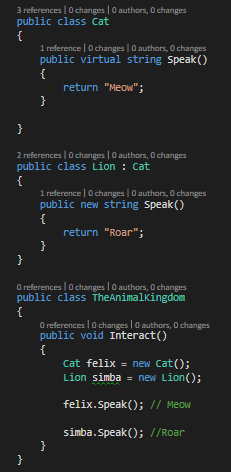
perhaps in our ‘Cat’ class we had listed a speak function.
When a Cat speaks, a cat says Meow.
When a Lion speaks, a lion says Roar

However, remember that a Lion is a Cat.
So, inheritance can drive one form of polymorphism.

That said, we will soon discover that there are many forms of polymorphism.
Haha, you might say that the topic of polymorphism is polymorphic itself!


These are both Cats,
but the base form of a cat Meows,
whereas the Lion form Roars.

As we continue with this topic our pairing focus will continue with Emotions.
Emotions are a prime example of polymorphism as well.

All of our emotions would extend from the base definition of emotion.
That means that an emotion has ‘many forms’ such as Happy, Sad, Fear, Love, Anger, Joy, etc.
This is one form of polymorphism.


In a similar sense,
sometimes different functions may be overloaded and behave differently when we feel specific emotions. Just like the overridden Speak() function, different emotions would have their own versions Feel() and Describe() as we discussed previously.
This is also polymorphism.


The two example are called ‘run-time’ polymorphism.
When we overrode the base class’s version of Speak() to produce the Lion’s version we were using run-time polymorphism. Similarly so, overrode definitions in the Happy Emotion, such as Describe() we were using run-time polymorphism.

The other main form of polymorphism In C# is called ‘compile-time’ polymorphism.
These forms are translated during compilation into machine code; however, prior to that they had the same name, but many forms.

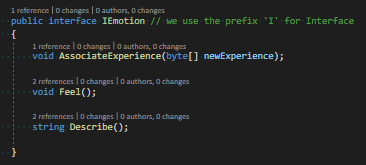
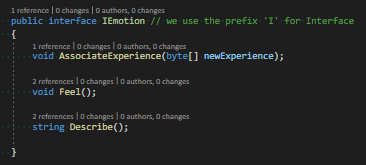
Previously we defined an IEmotion interface like this,

Let’s make a person class, which will have an interaction function.

What makes up an interaction?
Are all interactions the same?
Do we accept more input in some interactions than others?
Do we return more outputs in some interactions than others?

Complicated stuff, eh?     
Would you believe that polymorphism allows a computer to process this type of understanding!

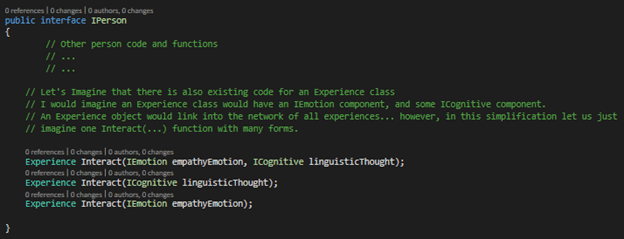
In this example we find ourselves with an IPerson interface defining the multiple forms of the Interact(…) method.

There is just one Interact method that we can call; however, depending on the input provided a different form of the method would be ran.

In this example we maybe have an Experience produced from Interact(…) which accepted both a reflected empathyEmotion, and an ICognitive component linguisticThough (language type) as input parameters.

However, we may also have an interaction where we had blocked the empathic input, and only accepting some ICognitive input. If that was the case, a different version of Interact(…) would be processed.

Finally, we may also have a type of Interact(…) where no ICognitive component was exchanged, only empathetic IEmotion reflection. In this case the third form of Interact(…) would be processed.

Specifically, this is function overloading.
You can also overload operators, like the + sign.
Doing that is called operator overloading and is part of this same type of polymorphism.

This family and type of polymorphism is referred to as ‘Compile Time Polymorphism’.
It is called that because when the compiler translates the data from C# to the machine language the polymorphism is encoded (machine calls do not have names like we see in the code, just addresses).

The first example of ‘Run Time Polymorphism’ was more complex from the computers point of view, so it was figured out after it had been compiled (when the program was actually running).

~~
Again, our human system is way more complex.
All output to another’s system is also reflected back as input into our own system.
Everything we do has feedback, emotions affecting thoughts, and thoughts affecting emotions. Heck even emotions affecting emotions, and of course thoughts affecting thoughts.
However, even for our human systems to accomplish this polymorphism comes into play.

~~

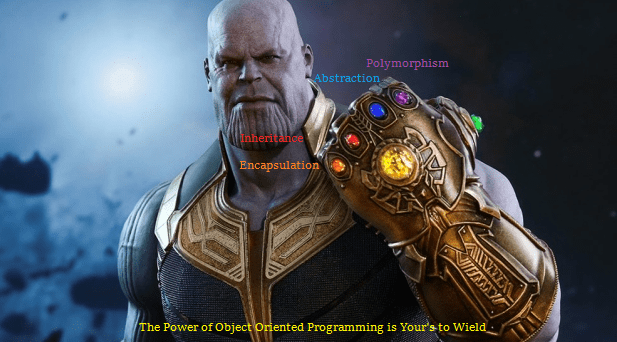
Encapsulations allowed us to organize and group functions and data together.
Inheritance allowed us to build on the shoulders of those code who came before us.
Abstraction allowed us to envision something more than we could fully imagine.
&
Polymorphism let us realize that we can have a call that is more than just a specific function.

Sure, it is true that there is a lot more to cover, but
These four fundamental principles allow for the recognition of development power.


This concludes the Fundamental Article Series.
Stay Tuned for more…

Abstraction

Abstraction

Today’s topic is abstraction;
I am going to use an example which is deeply familiar to all of us.

Emotions are a form of Data Abstraction


What is Happy, or What is Sad?
That is hard to answer.

I know what they are like… but I cannot say explicitly what they are?
When thinking of emotions,

I feel like they grow or change over time… our unique experiences have created deeper meaning.

Emotions I felt when I was young were simpler;
whereas, todays implementations are more complex.

With this,
It stands to reason that my experience of happy or sad,
is not the same as your experience of happy or sad.

But, if our definitions are different,
how can we even talk about emotions to each other?
The Answer is Data Abstraction

~~~
In Object Oriented programming the goal of Abstraction is to handle complexity by hiding unnecessary details from the user. By, hiding these complicating details we get a better impression of it. This allows the developer to implement new logic on top of the abstraction without even needing to understand or think about all that hidden complexity.

Next I am going to show a C# implementation of Emotion; however,
I should say that however our Brain works… whatever self-adapting gluon-quark magick occurs, I do not believe that it could be fully captured within the language of C#, so know that this analogy is just to connect a common daily form of abstraction into computer science.
___
We are able to self-adapt our code. I believe in part this is because in our inner-experience consists of two types of languages. The concrete logical bottom-up description (words), and the abstract affective big-picture top-down description (feeling). Within us these two worlds of thought and feeling give rise to self-adapting code. The idea of these two languages within us also explains why we sometimes can logically describe something but not understand it, just as we may be missing the words and yet do understand more than we can linguistically express.

Computer Science
Abstraction in computer science, being a fundamental, is a very vast topic.
The article is going to focus on a very useful form of abstraction which use extensively in our solution.
You will learn about keywords like, interface, abstract, virtual and more.


We will start with an interface.
It is often described as a contract; rules of what methods must exist for it to
call itself by this interfaces name (an IEmotion).

Let’s try to relate it to something common.


A controller or joystick is an example of an interface.
It defines the actions (buttons) that must exist, but not functionality.


For our IEmotion example,
This data contract is saying that any defined IEmotions must have a Feel()
function, a Describe() function and an AssociateExperience(…) function.
There is no implementations, just the return type, function name, and any
parameters. This is called the methods call signature.

From this interface all emotions can be implemented and described.
I mentioned that our version of the emotion evolves over our experiences, so to represent this in computer code we would see the following architecture.

The IEmotion interface allows for the initial implementation of any emotion where they all inherit from the IEmotion. These new various emotions would represent the version we are born with (inherited via genetics and
culture).

Finally, we will reach the level of our unique experience and by using computer science abstraction we will customize what we were born with, thus making our unique version of the class that corresponds to us.

The important of this interface is that we now know that any emotions will contain these definitions. Contracts like this allow developers to not have to worry about those details and complexity; it is enough to know that it is here and this is what it offers.

~
Now, let us look at an implementation of this IEmotion.


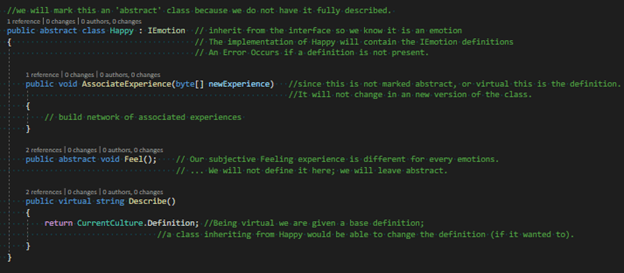
Here we have defined the ‘Happy’ emotion.
As you can see, it inherits from IEmotions, this means that we know it will offer those three functions that were described in the interface.

The first function we see is ‘AssociateExperience(…)’ it does not use any special keyword. This means that the definition we write here is the definition. We will not have an opportunity to change it in an inherited class. If we wanted to change it, we must change it here.

The next function Feel() is marked with the special keyword ‘abstract’.
This means that we are not going to solidify the definition with code here.
This is different that what we saw in the interface because an interface is just the signature; however, here we might have provided a definition.
The word abstract indicates that an inheriting class MUST provide it in some form.

It should also be noted that an abstract class object cannot be created in the code and used because it is abstract. A class which completes the abstraction through inheritance must exist which can be used in the code; More on this next.

The final function Describe() is marked with the special keyword ‘virtual’.
This means that we are going to provide a definition here. It is virtual in the sense that it might be changed, but it might not be changed either. If you created a new version of Happy you could leave the existing definition for Describe(), or you could create your own.

First, we created an interface, like a contract, so that we know any of these produced IEmotions will functions in this sort of way. The details are not present, but the big picture is clear.

There are two ways to look at something. Either from the top, starting with the big picture then moving towards the details, or from the bottom starting with the details moving towards the big
picture. Bottom Up thinking is more logical in nature because every part is gradually built up, whereas Top Down thinking is more abstract mainly because all those definitions are not discovered or built-up yet. Both linguistic form of thinking and abstraction is crucial to how we learn and adapt.

Without abstraction we could not be conscious… at least not in the way we are today.

~
Returning to computer science,
we have now created the IEmotion interface which defines the contract\structure of an emotion, we then created the Happy implementation of the IEmotion.

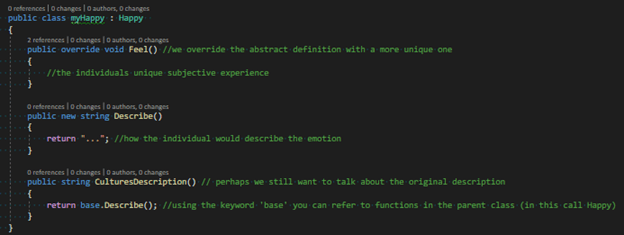
At this point, we now hold a version of the emotion within us that is different than at birth. Our unique experiences have shaped those emotions. The experience has become our own. Below is an example of how those abstract and virtual methods get expressed here.


The Feel() function was abstract; here in the personal implementation the special keyword ‘override’ is used. This allows us to write our own experience of Feel().

We did not have to modify the Describe() function, as a definition was already provided. However, the culture definition may not suite ones unique experience, so the special keyword ‘new’ in this context lets us write our own.

That said, perhaps we now want to write another function in case we want to describe the original definition. Here we use the special keyword ‘base’ to call describe, base.Describe(). If we had just called Describe() then we would have gotten our new definition.

As seen previously the ‘base’ keyword lets us talk about the class in which we inherit from, the parent class.

Thank-you for the emailed in question regarding why we used the keyword base in the article relating to inheritance. I hope this description makes it clear. Using the keyword base tells us that the code we are calling exists within the parent (base) class, and not in this child (derived)
class.
Sometimes, as shown above, we have two versions of the function and to differentiate them we use the keyword base.

There are many other forms of abstraction in computer science.
For instance, when we connect with a third-party, we use an API (Application Program Interface). We do not need to know the details about how the API works, simply knowing the offered functions and how to connect is enough to work with the API.

Another example of how abstraction helps us, is or instance if we wanted to ‘cast’ an integer of 2, to be a decimal of 2.0. The way that the computer understands how the two relate is due to abstraction.


~~
I hope this topic has been informative!

I know that there is a lot of material, and we only can absorb so much at
a time. Much like this topic, you may only now have an abstract form of
this information in your mind.

However, much like inheriting classes, before long those definitions will
become clear, and the topic of abstraction will be consolidated in your
minds.

Inheritance

Inheritance

T. M. Scanlon’s book ‘What We Owe to Each Other’ actually applies to this fundamental.
At least the title does, however, this is not the philosophy channel, so how does it apply?

If we reflect this title onto the action which it gives rise it becomes ‘What we give to each other’.
Much like in the medical world, inheritance gives something of value from the parent or ‘base class’ to the ‘derived class’.

  ** New Term Alert **  Derived Class & Base Class


Do not fear, a derived class is just a class which came from the other.
A child class is another term for a derived class, as is a sub-class.

Similarly, a base class is just the class it came from, the parent class.

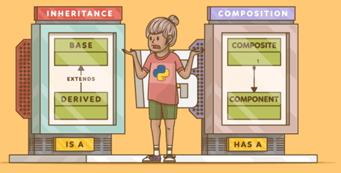
For consistency I have to mention composition. It is not the same as inheritance, and sometimes has been confused. To help clarify things, you can just imagine the type of relations which the two parts have between each other. With inheritance we see an ‘is a’ relationship, whereas with composition we see a ‘has a’ relationship.

I only want to briefly mention composition here because the contrast helps define both parts. To say that your composition, or code is reusing an existing component you would describe it with a ‘has a’ relationship.

Your composition, let us say, your Cat class ‘has a’ Tail component.
Your composite is the ‘cat class’ and the component is the ‘tail class’ here.
In this case, as animal architects we simply make use of the existing tail component in our cat composition.

What if we want to extend this Cat class into something fiercer like a Lynx.
or perhaps we wanted to make lots of cat-like classes, but didn’t want to reuse any ‘Purr()’ or ‘Pounce()’ code.
_

Inheritance can help make this task clear and fun!
Say we are given a Cat class

Perhaps you, a brand-new architect in the Codedverse have been tasked with designing some new cats.
After watching that there TigerKing you know that you want to recreate them, and no one could ever forget the majesty of the Lions. We also want a Lynx, and maybe some brand new cats… some sort of Lion and Tiger mix… a Liger… wait, they have that already? … sometimes animals do their own coding.

In the case of the Liger, it would be an example of Multiple Inheritance it has inherited attributes from both the Lion and the Tiger. If it were true multiple inheritance you could be correct to say that a Liger is both a Lion and a Tiger.

This example is not perfect since a Lion and Tiger share the same base class, however, as a generalization it demonstrates the idea well.

~

Here, given the Cat class from earlier,
we are presented with two new classes, and TheAnimalKingdom where they can interact.

We did not have to rewrite how to pounce or purr as it was inherited from the base class.
This is why we see the prefix ‘base.’ when we call the inherited functions.

In this case, SuperPurr() and SuperPounce() are part of the Lion and Tiger class respectively.
If we imagined creating that Liger where we inherited from both the Lion class and the Tiger class, looking past the scenario I mentioned, we would then see a new animal which could both SuperPurr() and SuperPounce() along with the base Purr() and Pounce() functions which were inherited.

Key take away: In keeping with the Object Oriented paradigm, do not rewrite the wheel class!
Inheritance allows us to keep our code clear and concise. Using heredity, we can see all the code in a single spot, and with encapsulation already on the scene what we are presented with is a clearly organized structures of data.

Encapsulation

Encapsulation

As a doctor, I want to have something simple that I can give to my patient which will
Combine the all of the patient’s vitamin needs.
I would also like some of the vitamins to have an extended release,
so that they can take it just once per day.             

We want to bundle the data (vitamins), along with the methods which operate on that data [time-release, the patient running takeVitamin() function, etc].

The benefit of this action simplifies the medication to the patient by making it easier to work with.
Unless they want to, they do not need to know all the vitamin chemical names, or how gradually certain ones release. They do not need to know that ‘private’ stuff in order to interact with it.
In programming you can think of the ‘class’ as a capsule. The patient does not need to know the inner details about the capsule in order to use it. Simply take medication, and this result is expected.

This also describes encapsulation in programming.
~~
First let’s mention what you find inside a ‘.cs’ (C Sharp) file.

In C# you will notice that as you open the file you see a couple common things.
The stuff at the top is called ‘using’ statements. These statements let you know what other pieces of code have been made part of this program.

Afterwards, you will find something called the ‘namespace’.
Namespace, is just a space where you can publicly name functions and objects within that space names must be unique, however, between namespaces the same name could exist.
For instance, you can have two controls named TabControl if one belongs to the DevExpress namespace where the other belongs to the Windows namespace.

The next thing you will notice in the file is where we begin our connection to encapsulation.
Class; a class is a recipe or template. Once you write the recipe the system can make those ‘objects’. An object will have an internal state (variables and data), as well as behaviors (functions).

The code description in the class encapsulates the idea of the object, and how the object works.

A class is just one example of encapsulation;
this term in computer science has a wide array of applications.

Data Hiding

As I hinted towards this with the time-release vitamin analogy, sometimes encapsulation is about hiding data. The functions which helped make the timerelease() routine work can be hidden. Before a class, function or variable is named and given a type which represents it, you will see something called an Access Modifier. This will let us know if the information is private, or publicly accessible. Please note that there are more access modifiers than these two; however, these two are the most common for which we will start with.

Also, let me know if there are any topics you would like to see covered outside of the fundamentals, such as going more in-depth into access modifier.

~~~~

Public – Means that the class, function or variable can be seen by something outside the class. So, like, I mentioned that class is a recipe. If the recipe created that object, which data or functions about that object should be available.


Private – Means that the class, function or variable cannot be seen or used outside the class.
So, code within the capsule can see this sort of data or functions, however, code outside of the capsule would not be aware of it.
~~~~~

o\_/o   Circular Reference Detected in regards to the term class and public.
So, in the case of a class being public or private… generally, no, you will not have a private class… unless you had nested a second class inside or some other scenarios. There are other access modifiers for a class, for instance, if you only want a class to be shown to the DLL (or assembly) in which it belongs then you might use the word ‘internal’ instead of ‘public’.


Assembly – what is a DLL or Assembly from a code perspective?
After writing your code you compile it into either an executable or a library. The executable you would run, but the library or assembly is something for other code to use. For instance, if you wrote some calculation code, you might produce an assembly for reuse in other projects. You might want the universe of your assembly to publicly see the data, but perhaps not a third-party company using the assembly, in this case you would use the access modifier of internal.

Sometimes in development it is important to hide some inner details of your object. By doing so, the capsules act like Lego blocks. Build an object, and hook it together with another. By doing this a developer can easily look at the object and know what data it shares, and what functions it exposes.

* NEW Computer Science Terms: Data Structure *

These capsules, and classes are an example of something called Data Structures, to which a whole topic should be dedicated. To simplify, a data structure is just a collection of data that has some rules. How is the data stored, indexed/organized, and how the data can be accessed. Data Structures also define relationships as to how the data interacts.


As we write code to organize data these objects which we produce are data structures. Encapsulation in object-oriented programming allows the things we produce to operate both onto the outside world, but also onto the world within their capsule.
The world of their inner state, and how it responds.

Object Oriented Programming

Object Oriented Programming

Object Orient Programming (OOP) is an approach to programming (paradigm)
The approach mimics the world we live in.                                                               
In our world we interact with objects, and perform actions onto them.          
We may have a car, and we may want to unlock the car, or start the car.       

This is how we naturally interact with things.                                                            It is the way we already think, and as such it is a great way to program.                                                            

Before we get serious, let’s start with a whimsical story…
________________________________________________________________________

Originally there was nothing,
            without data variations no program could exist.
            However, something infinitely simply was introduced,
            but from it would come the potential for something infinitely complex…
anything… everything.

Binary, it seems so simple… and it is.
But, by allowing a difference, a variance… suddenly so much more is possible.

Perhaps like some digital big bang, a Codedverse was born.
Suddenly mere symbols… instructions… code… could become things.
From that the perfect program was designed for the society to live within.

But, there was a problem.
The society that tried to describe the perfect program did not really know what perfect was…
Suddenly a program which seemed great had a sort of crime appear.
These bugs were wreaking havoc on the perfect functionality of the program

To help fix things,

A team of exterminators got on the scene!
…but, it seemed as fast as they could remove the bugs that more would appear.

It was not until unexpected insight appeared, which lead to a transformation in the Codedverse.

The wisdom was a simple observation…
These bugs are symptoms of the imperfect design of the program that their society created.

The bugs only looked like ‘objects\things’ which were separate from the program.
This realization helped restore clarity… that all these things… all these objects… all these bugs…
are code or code byproducts… which is to say communication, and stored description.

Object Oriented Programming is like Magical Alchemy.
Words becomes Things… Objects.
Gradually becoming more and more complex,
until we have the coded universe.
________________________________________________________________________


… As we shift back from the fantasy back to reality,
let’s take a moment pause in the year 1999.
As we arrive, we find ourselves in a Famous Players movie theater.

The movie The Matrix is playing… lets watch

*        Cuts to a Scene already in progress        *

Cypher: I don’t even see the code anymore… I just see blonde, brunette, redhead.
______________________________________
The statement is still important though.
It is important because when we use our computer,
we also do this.

In reality, we are looking at a series of pixels.  
            I won’t get too off topic into perceptual psychology…
            However, even color is code, it is our brains representation of
            electromagnetic vibrations. However, our user interface to that is the
            experience of color. This is also true with pitch perception…
                  however, for more information on
                  that topic please subscribe to my psychology channel.
           
            We are just so sophisticated at recognizing patterns we do not really think of it as code anymore. We do it so easily even pausing to recognize this can be challenging. Now it is clearly a button… a tab, a date edit… but, really it is active code.

Simply put…
                         we don’t even see the code anymore,
                                    we just see Button, XtraRichEdit, Label.

All these things are just code, that is to say they are description.
All these objects are just from the illusion of code in motion.

All the components we use to create our program is just others code.
From Words to Things, that is the magic of Object-Oriented Programming.

Now to get serious,
there are other approaches to programming, such as ones which focus on the procedure or function of the program,
but Object-Oriented Programing gives us a way to write like the world appears, and it focuses on being concise and not repeating yourself.
Once you make something once, re-use it!
If you already made the Wheel class… use it in the Car class, don’t redesign the wheel!

Write the recipe to make the things, and then reuse those things.
While I have already mentioned inheritance, these are the big pillars of object-oriented programming.                As such these will be the next topics:

                        Encapsulation, Abstraction, Inheritance, and Polymorphism.