Distraction: Source or Symptom?

Distraction: Source or Symptom?

Previously I wrote an article entitled ‘Listening in a Distracting World’.
In this article I suggested that today, people have shorter attention spans and are listening less due specifically to Distraction as the source of the issue.

In my recent audiobook,
I felt this idea flipped on its head when a question was asked:
What if Distraction is a symptom, and not the source of the issue?

Eerily in the last three audiobook that I have listened to one topic has persisted.
This is the idea of ‘Bad Faith’, and the importance of Good Faith.

See, ‘Bad Faith’ means that you are either putting the entire power of control onto another, or reserving it for yourself. If someone is acting in bad faith, they may feel that the outcome is fully in their power.
Just as someone acting in bad faith may feel that someone else is fully to blame.

When we interact, that interaction is with another, and a conversation is more akin to a session of improvisation or tossing clay than anything else. Let me explain, in improv the idea is to accept where you find yourself in the story, and to build upon what your partners have set up.
Similarly so, you could consider a conversation like a piece of clay.
Unformed, this clay has the potential to become anything.
With Good Faith, we accept the clay or topic as it is presented to us.
We nurture what is forming, shape it a bit, and then toss it back to our partner.

If a participant has an advanced desire of what the comedy sketch, or clay should become and will not let it go… well, they are displaying bad faith. Sure we may have ideas of what we may desire the clay to become; however, when showing good faith, we accept and respect the contributions of others.
We suspend our own desire, and instead build towards mutual desire.

Perhaps Distraction is just the easy out.
A quick way to forget?
Or perhaps, the willingness to be distracted is a symptom of something else.
See Good Faith, can be challenging.
It means letting go of the clay,
and letting go of what you so want it to become.
It means putting your faith in another, respecting their contributions,
and being ok with what ever the clay becomes.

This gets back to self-control.
Managing ones fears, and desires.
As well as Suspending the self, for another.

I think it may be easy to objectify a problem, and say that this is because of that.
such as saying, ‘Distraction is the problem in society, not me’.
However, again putting the onus of responsibility solely on one thing is also a form of bad faith.

Sure this world has allowed for more distractions.
But, if I am distracted, it is because I allowed myself to be lulled by it.
Good Faith means managing emotions, and believing.
Distraction is a quick out and into another emotion for a moment.

Distraction is not the source.
When one allows themselves to be easily distracted they are escaping.
While an escape may be ok, getting back to the challenge is important.
It communicates that we care, and that a distraction can never be enough for us to forget.

If distraction is temptation then
returning attention and caring is the cure.
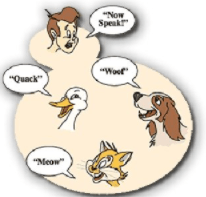
Polymorphism

Polymorphism

Polymorphism is a word that sounds complicated; however, really it is not as wild as it first appears.
When we look at the words etymology (history), we see Greek roots for ‘poly’ and ‘morph’.
The direct translations is ‘many forms’, and ‘ism’ means having. So, having many forms.

Do you remember a while back in our inheritance class when we made different types of animals?
Specially let’s combine this with what we learned in the abstraction class.
How you can have a function defined virtually which allows an inheriting class to override it if it wanted.

For instance,

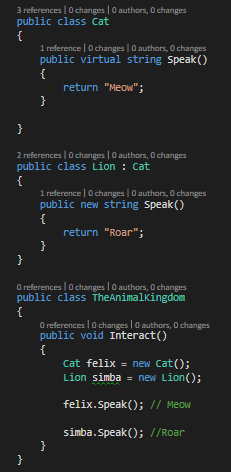
perhaps in our ‘Cat’ class we had listed a speak function.
When a Cat speaks, a cat says Meow.
When a Lion speaks, a lion says Roar

However, remember that a Lion is a Cat.
So, inheritance can drive one form of polymorphism.

That said, we will soon discover that there are many forms of polymorphism.
Haha, you might say that the topic of polymorphism is polymorphic itself!


These are both Cats,
but the base form of a cat Meows,
whereas the Lion form Roars.

As we continue with this topic our pairing focus will continue with Emotions.
Emotions are a prime example of polymorphism as well.

All of our emotions would extend from the base definition of emotion.
That means that an emotion has ‘many forms’ such as Happy, Sad, Fear, Love, Anger, Joy, etc.
This is one form of polymorphism.


In a similar sense,
sometimes different functions may be overloaded and behave differently when we feel specific emotions. Just like the overridden Speak() function, different emotions would have their own versions Feel() and Describe() as we discussed previously.
This is also polymorphism.


The two example are called ‘run-time’ polymorphism.
When we overrode the base class’s version of Speak() to produce the Lion’s version we were using run-time polymorphism. Similarly so, overrode definitions in the Happy Emotion, such as Describe() we were using run-time polymorphism.

The other main form of polymorphism In C# is called ‘compile-time’ polymorphism.
These forms are translated during compilation into machine code; however, prior to that they had the same name, but many forms.

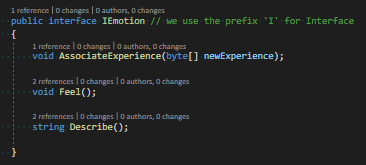
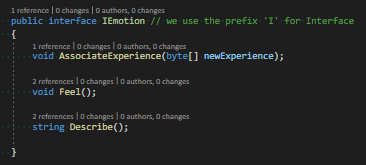
Previously we defined an IEmotion interface like this,

Let’s make a person class, which will have an interaction function.

What makes up an interaction?
Are all interactions the same?
Do we accept more input in some interactions than others?
Do we return more outputs in some interactions than others?

Complicated stuff, eh?     
Would you believe that polymorphism allows a computer to process this type of understanding!

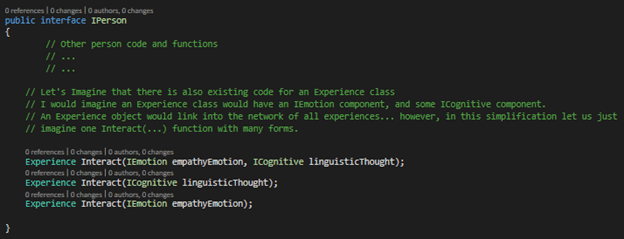
In this example we find ourselves with an IPerson interface defining the multiple forms of the Interact(…) method.

There is just one Interact method that we can call; however, depending on the input provided a different form of the method would be ran.

In this example we maybe have an Experience produced from Interact(…) which accepted both a reflected empathyEmotion, and an ICognitive component linguisticThough (language type) as input parameters.

However, we may also have an interaction where we had blocked the empathic input, and only accepting some ICognitive input. If that was the case, a different version of Interact(…) would be processed.

Finally, we may also have a type of Interact(…) where no ICognitive component was exchanged, only empathetic IEmotion reflection. In this case the third form of Interact(…) would be processed.

Specifically, this is function overloading.
You can also overload operators, like the + sign.
Doing that is called operator overloading and is part of this same type of polymorphism.

This family and type of polymorphism is referred to as ‘Compile Time Polymorphism’.
It is called that because when the compiler translates the data from C# to the machine language the polymorphism is encoded (machine calls do not have names like we see in the code, just addresses).

The first example of ‘Run Time Polymorphism’ was more complex from the computers point of view, so it was figured out after it had been compiled (when the program was actually running).

~~
Again, our human system is way more complex.
All output to another’s system is also reflected back as input into our own system.
Everything we do has feedback, emotions affecting thoughts, and thoughts affecting emotions. Heck even emotions affecting emotions, and of course thoughts affecting thoughts.
However, even for our human systems to accomplish this polymorphism comes into play.

~~

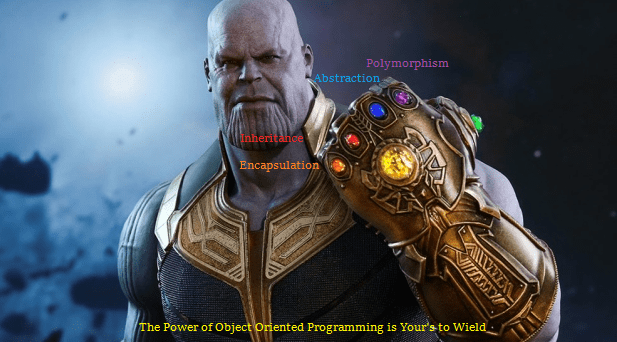
Encapsulations allowed us to organize and group functions and data together.
Inheritance allowed us to build on the shoulders of those code who came before us.
Abstraction allowed us to envision something more than we could fully imagine.
&
Polymorphism let us realize that we can have a call that is more than just a specific function.

Sure, it is true that there is a lot more to cover, but
These four fundamental principles allow for the recognition of development power.


This concludes the Fundamental Article Series.
Stay Tuned for more…

1001

1001

1001 you might say that you just the number 9.
Sure you’re a number, but a number that is kind.
A number that listens, a number that hears,
a number that’s safe to share your fears.

I do not think there is another number quite like that 1001.
Not with a perfect combination of honest, direct, and fun.

1001 you may think that you are just fine,
but I do not think you realize the power of being the number 9.

In math you are lucky, and a perfect power too.
1001 is more than a number, you’re you.

And, yes it is true that your are odd, but you are also unique.
You’re the only odd single-digit composite number I want to seek.

Read Forward or Back, the answer is the same,
1001 is my favourite number, and this I will always proclaim.

Listening in a Distracting World

Listening in a Distracting World

~~
If this page took more than five seconds to load,
you probably didn’t bother to read it.

If it did load, but your attention was not captured in about ten seconds,
you probably would not continue to read it.
~~


Attention, Patience, and Listening where has it gone?
Why are so many in such a hurry?
…and why to some does a few minutes in silence without a piece of technology seem like an eternity of torture?

This is also not something isolated either, venues are getting shorter and more attention grabbing.
For instance, Second City skits use to be about twelve minutes,
but, now they are about five minutes because that is all the attention that people will give now a days.

What is this happening?
Why are things getting so complicated,
and why is it that listening is suffering on a global level?

Part of the answer to this relates to the ‘Attention Economy’.
Businesses pay big bucks for your attention, and they pay even more so their marketing outlet is louder and more captivating than their competitor’s.

Today more than ever we live in a world of distraction.
With this new market every distraction is potential cashflow, and in a capitalistic world distraction means just one thing… money.

Every buzz on your phone, every chime, every television commercial,
and every song is designed to tune you in.
However,
when we tune into a distraction… we also tune out the present moment.
What is worse is that giving in to distraction is habit forming, and rather addictive.

Feel a bad emotion? Then just turn on the tv… ahh, that is better 😐
Worried about something… don’t bother working on it… as there is a shiny plastic bag over there which will take your mind off the discomfort much more quickly and easily.


The ability for us to hold our attention, imagine another’s experience, and empathetically feel what they feel is one of the most important things we can do. It allows us to actually connect with others, and I mean actually connect… to see them… to experience them… and to understand them.

But, today active listening, and our daily attention is suffering.
The ultimate cost of this is our relationships.

Technology like Social Media has allowed us to filter what gets into our bubble.

  Don’t like this?    
                              Then click to not show you this type of stuff…
         Like this?
                           Then just click like.


Suddenly we just see what we want to see, and share what we want to share.
We created a device to make us the center of our own world… no wonder why fake news, miscommunications, and disconnection has become so prevalent.

As our attention has shrunk our ego’s have grown… but, these ego boosting behaviors are not actually what we are craving.
Much like pulling a lever on a slot machine, the likes to these self-interested posts are like an empty fix. A hit of feeling WorthIt, a hit of feeling Admired… followed by a continued emptiness.

But, Hey, after all, maybe, just maybe that next pull on the lever is all that is needed.
One more hit of self-esteem then everything will be better

However, beyond this veneer what we really crave is connection, not admiration.
The issue is that the self-indulging act of ‘me-ness’ will not produce connection.
The soul craves true connection, and the marvel of technology while bringing us closer together has also moved us further apart.

Please,
the next time you hear a ding or buzz don’t let it take you.
They say that once attention has been broken it really takes a good 30 minutes before you get back into that flow state. Listening also becomes a flow state between two people when we remain present. Practicing meditation and mindfulness can help give us back the power to stay present.

Remember,
we created this technology to serve us, just as how our emotions evolved to help us.
Though, with any complicated system a certain respect is required; a certain pause.
Do not let distractions rob you of your presence; practice mindfulness.
Reclaim your awareness today! ❤

Abstraction

Abstraction

Today’s topic is abstraction;
I am going to use an example which is deeply familiar to all of us.

Emotions are a form of Data Abstraction


What is Happy, or What is Sad?
That is hard to answer.

I know what they are like… but I cannot say explicitly what they are?
When thinking of emotions,

I feel like they grow or change over time… our unique experiences have created deeper meaning.

Emotions I felt when I was young were simpler;
whereas, todays implementations are more complex.

With this,
It stands to reason that my experience of happy or sad,
is not the same as your experience of happy or sad.

But, if our definitions are different,
how can we even talk about emotions to each other?
The Answer is Data Abstraction

~~~
In Object Oriented programming the goal of Abstraction is to handle complexity by hiding unnecessary details from the user. By, hiding these complicating details we get a better impression of it. This allows the developer to implement new logic on top of the abstraction without even needing to understand or think about all that hidden complexity.

Next I am going to show a C# implementation of Emotion; however,
I should say that however our Brain works… whatever self-adapting gluon-quark magick occurs, I do not believe that it could be fully captured within the language of C#, so know that this analogy is just to connect a common daily form of abstraction into computer science.
___
We are able to self-adapt our code. I believe in part this is because in our inner-experience consists of two types of languages. The concrete logical bottom-up description (words), and the abstract affective big-picture top-down description (feeling). Within us these two worlds of thought and feeling give rise to self-adapting code. The idea of these two languages within us also explains why we sometimes can logically describe something but not understand it, just as we may be missing the words and yet do understand more than we can linguistically express.

Computer Science
Abstraction in computer science, being a fundamental, is a very vast topic.
The article is going to focus on a very useful form of abstraction which use extensively in our solution.
You will learn about keywords like, interface, abstract, virtual and more.


We will start with an interface.
It is often described as a contract; rules of what methods must exist for it to
call itself by this interfaces name (an IEmotion).

Let’s try to relate it to something common.


A controller or joystick is an example of an interface.
It defines the actions (buttons) that must exist, but not functionality.


For our IEmotion example,
This data contract is saying that any defined IEmotions must have a Feel()
function, a Describe() function and an AssociateExperience(…) function.
There is no implementations, just the return type, function name, and any
parameters. This is called the methods call signature.

From this interface all emotions can be implemented and described.
I mentioned that our version of the emotion evolves over our experiences, so to represent this in computer code we would see the following architecture.

The IEmotion interface allows for the initial implementation of any emotion where they all inherit from the IEmotion. These new various emotions would represent the version we are born with (inherited via genetics and
culture).

Finally, we will reach the level of our unique experience and by using computer science abstraction we will customize what we were born with, thus making our unique version of the class that corresponds to us.

The important of this interface is that we now know that any emotions will contain these definitions. Contracts like this allow developers to not have to worry about those details and complexity; it is enough to know that it is here and this is what it offers.

~
Now, let us look at an implementation of this IEmotion.


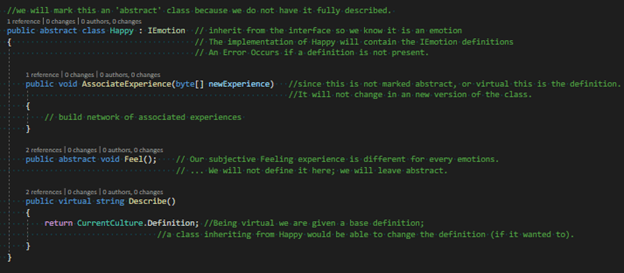
Here we have defined the ‘Happy’ emotion.
As you can see, it inherits from IEmotions, this means that we know it will offer those three functions that were described in the interface.

The first function we see is ‘AssociateExperience(…)’ it does not use any special keyword. This means that the definition we write here is the definition. We will not have an opportunity to change it in an inherited class. If we wanted to change it, we must change it here.

The next function Feel() is marked with the special keyword ‘abstract’.
This means that we are not going to solidify the definition with code here.
This is different that what we saw in the interface because an interface is just the signature; however, here we might have provided a definition.
The word abstract indicates that an inheriting class MUST provide it in some form.

It should also be noted that an abstract class object cannot be created in the code and used because it is abstract. A class which completes the abstraction through inheritance must exist which can be used in the code; More on this next.

The final function Describe() is marked with the special keyword ‘virtual’.
This means that we are going to provide a definition here. It is virtual in the sense that it might be changed, but it might not be changed either. If you created a new version of Happy you could leave the existing definition for Describe(), or you could create your own.

First, we created an interface, like a contract, so that we know any of these produced IEmotions will functions in this sort of way. The details are not present, but the big picture is clear.

There are two ways to look at something. Either from the top, starting with the big picture then moving towards the details, or from the bottom starting with the details moving towards the big
picture. Bottom Up thinking is more logical in nature because every part is gradually built up, whereas Top Down thinking is more abstract mainly because all those definitions are not discovered or built-up yet. Both linguistic form of thinking and abstraction is crucial to how we learn and adapt.

Without abstraction we could not be conscious… at least not in the way we are today.

~
Returning to computer science,
we have now created the IEmotion interface which defines the contract\structure of an emotion, we then created the Happy implementation of the IEmotion.

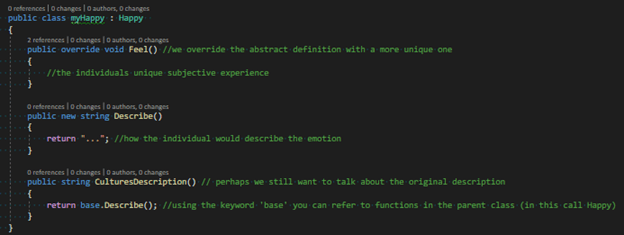
At this point, we now hold a version of the emotion within us that is different than at birth. Our unique experiences have shaped those emotions. The experience has become our own. Below is an example of how those abstract and virtual methods get expressed here.


The Feel() function was abstract; here in the personal implementation the special keyword ‘override’ is used. This allows us to write our own experience of Feel().

We did not have to modify the Describe() function, as a definition was already provided. However, the culture definition may not suite ones unique experience, so the special keyword ‘new’ in this context lets us write our own.

That said, perhaps we now want to write another function in case we want to describe the original definition. Here we use the special keyword ‘base’ to call describe, base.Describe(). If we had just called Describe() then we would have gotten our new definition.

As seen previously the ‘base’ keyword lets us talk about the class in which we inherit from, the parent class.

Thank-you for the emailed in question regarding why we used the keyword base in the article relating to inheritance. I hope this description makes it clear. Using the keyword base tells us that the code we are calling exists within the parent (base) class, and not in this child (derived)
class.
Sometimes, as shown above, we have two versions of the function and to differentiate them we use the keyword base.

There are many other forms of abstraction in computer science.
For instance, when we connect with a third-party, we use an API (Application Program Interface). We do not need to know the details about how the API works, simply knowing the offered functions and how to connect is enough to work with the API.

Another example of how abstraction helps us, is or instance if we wanted to ‘cast’ an integer of 2, to be a decimal of 2.0. The way that the computer understands how the two relate is due to abstraction.


~~
I hope this topic has been informative!

I know that there is a lot of material, and we only can absorb so much at
a time. Much like this topic, you may only now have an abstract form of
this information in your mind.

However, much like inheriting classes, before long those definitions will
become clear, and the topic of abstraction will be consolidated in your
minds.

Epigenetics: Genetic Plasticity

PsychologyCode Series – Article 5 [ Originally Written on August 1, 2013 ]
Epigenetics: Genetic Plasticity

In order to wrap up this weeks series on neuroplasticity, the power of the brain to change, I thought we would look a little deeper into the nucleus of our design. Today we will discuss how the ‘brain’ within every cell of our body is also plastic and adaptable.
The nucleus of a cell can be thought of as its brain, and all the information inside is stored within our DNA. Current understanding of DNA has paved the way for new sciences, technologies, and it has helped billions of people along the way. This understanding, however, has also creates an unsettling implication: ‘If everything in my life is determined by my DNA, am I just a mechanical machine following a predetermined code?’. Although this ‘genetic understanding’ has given much insight into the way we work, what is it also implying about free-will?

Consider the following:
If someone found out they had a genetic predisposition for a certain disorder or behaviour they may not even try to overcome it. Imagine how troubling it would be to know that your genes were preventing you from achieving dreams, and also being told that this outcome of your life is essentially predetermined.

In order to demonstrate this point more clearly lets take a moment to look at the science fiction movie titled Gattaca.
In this future set film DNA understanding has influenced everything. In fact every new born is now required to have their DNA analyzed and put on record. Based on the analysis certain future paths are immediately ruled out. People with aggressive tendencies are likely to be treated more like criminals even before they commit any crimes. In the case of the main character ‘Anton’, his dream of becoming an astronaut is shattered when he learns that there is a high probability he will develop a fatal heart condition. As a result his career path becomes limited from birth. I will not spoil the plot by saying anything more. If you have not seen this movie I strongly recommend doing so.

The consequences of a strictly predetermined code running us is unsettling, however, with the new concept of epigenetics we may be able to have our genetic ‘cake’ and change it too. You see there is so much information within our DNA. In order to talk about this heap of information we usually break it down, and describe specific Genes.

A Gene is like the code for a module which produces proteins to perform certain functions. All of these protein ‘modules’ work together in order to give rise to us. If a bit of DNA was damaged within the cells we usually can still function because there is a certain amount of redundancy within our code. In other words, we may have multiple genes capable of performing similar tasks, but in a different ways.

The term Epigenetics literally means ‘Above the Genes’. It is a method of changing the way our cells interpret our genetic code, and in turn, a method of changing our genetic expression. Below is a diagram that describes methods by which our cells are able to ‘non-destructively modify’ our DNA.

Pictured here are two methods of altering our genetic expression.

These changes happen as a result of our environment, activities, emotions, and thoughts. Our cells actually learn from experience which genes served them well, and which genes were troublesome. The cells then can change the probability of those genes being implemented within their day-to-day life. What is even more fascinating is that it seems these epigenetic flags are inherited to our cells offspring. The offspring would then continue to make changes based upon their unique experience/environment, but this still means that the cells within our body are unique with a sort of ‘epigenetic memory’ of not only their own, but also their parents experiences.

Previously we use to think in black and white terms —
‘Why am I the why I am: My Upbringing?, or my Genetics?’
However, with epigenetics on the scene it is more accurate to say that we are born with a ‘Fate Framework’, and throughout our lives we evolve and make this framework our own unique life experience!

More Information:
Epigenetics: DNA Isn’t Everything
Epigenetics Study
Epigenetic Changes to Fat Cells Following Exercise

NP: Phantom Pain

PsychologyCode Series – Article 4 [ Originally Written on July 30, 2013 ]
Neuroplasticity: Phantom Pain

Today we are going to talk about something ghostly – The Phantom. As we talked about earlier, what we experience (our perception) is a complex product built from memories of the past, information from the present, and expectations about the future. Our brain does its best to build an experience of reality from all of these sources. However, when the brain loses input from certain organs it ends up needing to rely on other sources, and when it does this it is more likely that it will make mistakes. While normally the brain can learn from its mistakes and correct itself, without some sort of feedback to recognize the errors its self-correction process can become very challenging. In fact, sometimes these mistakes result in a perception false perception, such as a ghost or phantom.

During the war, many soldiers underwent amputations in order to prevent infections from certain wartime injuries. In a lot of cases, the soldiers lost appendage was not the worst part of an amputation. Many times they would wake up one morning only to realize they could feel their arm, for instance. They would even feel their ‘phantom’ hand reach out to open doors, or to attempt to catch them when they fell.  The worst part of this was that many times their phantom would return with all the pain it experiences during the moment of the incident. It would seem that this persistence of memory was being projected from the brain into an all too real experience. Some patients suffering from this condition also experienced their phantom clenching its phantom fingernails into the phantom hand, and others who did not experience intense pain still experienced their phantom as a paralyzed dead weight. With no sensory feedback to tell the brain that the hand no longer was there it simply stewed in these perceptions. These symptoms were first reported before the acceptance of neuroplasticity, and because of this doctors did not have any solutions to offer. In fact, doctors at the time were not even likely to appreciate the realness of this perceived pain. Sure the pain may have been psychological, but it still felt as real as any other type of pain.

A doctor by the name of Vilayanur S. Ramachandran had theorized about the connection between phantom limbs and neuroplasticity. He believed that the phantom experience was a result of the lack of sensory feedback. With no information relating to the ‘status’ of the hand, the brain had to make sense or fill in the missing information in another way, such as projecting memories or interpreting the lack of sensory information as paralysis. Vilayanur believed these phenomena were occurring because the brain was not receiving information any sensory information to tell it otherwise. He thought that if this illusion seemed so real then maybe another illusion could be used to invalidate this false phantom perception. He constructed a simple device called a mirror box which was designed to trick the brain into thinking it was receiving real sensory information from the missing limb. Below is a very rough sketch of the mirror box. The mirror would reflect the image of the functional hand in order to produce an illusion that their amputated hand had returned.

A box with a mirror was used to reflect the image of a patient’s function hand into the space where the patient’s phantom was perceived.

When patients used this mirror box miraculously they perceived their phantom hand as if it had come back to life. The perceptions of clenching, pain, and the paralyzed dead weight feeling all subsided. What was even more remarkable is that after continual treatment with the mirror box many patients would awake one morning and find that their phantom had vanished. While the mirror box technique was not effective for every patient the results were still very astonishing. Modern techniques have also been developed using a virtual reality device in order to produce the illusion of sensory feedback from the missing limb.

The brain is pretty good at figuring things out, however, when it gets stuck sometimes all it needs is a simple nudge in the right direction to help it along.

More Information:

The Mirror Cure for Phantom Pain
Phantom-Limb Pain Eased with Virtual Reality
Mirror Therapy for Phantom Limb Pain

NP: A Regained Sense of Balance

PsychologyCode Series – Article 3 [ Originally Written on July 24, 2013 ]
Neuroplasticity: A Regained Sense of Balance

Today I thought I would continue with another instalment about Neuroplasticity (abbreviated in the title as NP). On top of our tradition five senses we also have a sense of balance, which is largely related to our sense of hearing. It is not a sense we think much about because it works so well; however, for those who lose this sense the results are devastating.

Just as our sense of hearing works through the movements of tiny hairs within the ear, so does our sense of balance. Position, movement, and acceleration are all detected within the vestibular system of the inner ear. Essentially this system is composed various fluid filled chambers at different orientations. The movements of the tiny hairs within these fluid filled chambers are decoded giving us our sense of balance, position, and movement.

Our brain decode movements of tiny hairs within fluid filled chambers to give us our sense of equilibrium.

For a lady by the name of Cheryl Schiltz the consequences of a damaged vestibular system became painfully clear. Cheryl was prescribed gentamicin to treat an infection she had at the time, and while the medication treated her infection it also wrecked havoc on her vestibular system. The gentamicin destroyed roughly 98% of her sense of balance, and due to the damages the associated nerves ended up transmitting invalid signals to the brain. The result of this was described by Cheryl as an intense perpetual feeling of falling. The sensations were so debilitating that her body responded as if she was actually falling. These ‘wobbles’ were so strong that she could not stand still or even walk properly without falling down. On top of the physical distress, the psychological effects of her condition were extremely traumatic. She lost her job as an international sales representative, and had to file for disability.

Cheryl saw many doctors who all who told her that the damages were irreversible, and that she would never have her normal life back. However, one doctor by the name of Paul Bach-y-Rita (who I mentioned in my previous article) believed their was hope through his beliefs of an adaptable brain. While many doctors believed absolutely that the brain does not have the capacity to change itself (in any drastic degree) Paul Bach-y-Rita was willing to challenge the current beliefs and put neuroplasticity to the test.

In a similar way he remapped vision through the sense of touch he devised a small device which would attach to Cheryl’s tongue and take the place of her vestibular system. The device itself contained a piece of technology know as an accelerometer (these are commonly now found in smartphones). Various orientation, movement, and acceleration information was presented to her tongue in the form of subtle electrical sensations. To Cheryl these sensations would have felt like the tingles produced from a carbonated beverage. For instance if Cheryl leaned forward the tip of her tongue would tingle, if she leaned to the side then the side of her tongue would tingle, and so forth in order to encode the various orientations, movements, and changes in movement.

Astonishingly upon wearing this device Cheryl’s brain very rapidly adjusted to this new information, and almost like a miracle, her wobbles stopped. She no longer felt like she was falling. While wearing this device her nightmare had disappeared. The brain was able to start processing the new input presented through sensations on the tongue and use this information to produce a new sense of balance. However, what happened next showed that the brain is even more adaptive than could have been imagined.

After wearing the device for about a minute it was removed, but her symptoms did not suddenly return. There seemed to be a residual grace period which followed for around 20 seconds before her symptoms returned. When Cheryl wore the device for longer the residual period was extended in an exponential way. Her brain was not only remapping her sense of balance, but it was beginning to learn by comparing the signals between her tongue and the damaged part of her inner ear. Although only about two percent of her vestibular system was functioning correctly, her brain was able to focus on those signals and filter out the rest. This sensory remapping device gave her brain the ability to know the difference between valid and invalid signals. Once her brain could isolate the valid signals it was able to draw from the functioning part of vestibular system and even reinforce the valid signals. Paul Bach-y-Rita sensory remapping device allowed Cheryl to reclaim her sense of balance as well as her life.

More Information:
New Tools to Help Patients Reclaim Damaged Senses
The Brain is an Organ that just won’t be Contained

The following links also mention an extension of the tactile vision chair where instead the tongue is used due to its increased sensitivity.
Can You See With Your Tongue?
Balancing Act

A Fantastic Book on the subject of Neuroplasticity,
The Brain That Changes Itself – By: Norman Doidge

Neuroplasticity: An Introduction

PsychologyCode Series – Article 2 [ Originally Written on July 21, 2013 ]
Neuroplasticity: An Introduction

Over the next while I will be preparing a series of instalments on the subject of neuroplasticity. During this first instalment I will briefly explain neuroplasticity, mention previous thoughts on the subject, and provide a remarkable example from the late 60s; a device which can allow the blind to see.

The word Neuroplasticity refers to the brains incredible ability to change and mold. The first part of the word ‘neuro’ comes from the word neuron. Neurons are the ‘thinking’ cells which interconnect and make up your brain. The second part of the word ‘plasticity’ refers to the characteristic of plastic which allows it to be easily shaped, changed, and molded. Previously when scientists adopted a mechanical view of the world they also formed the belief that the brain must too function this way. From this further damaging beliefs were born, such as damaged brain cells could not be replaced. Due to this self-limiting belief many people simply lived accordingly under the impression that their brain will not regenerate. Some scientists, however, refused to believe this mechanical model, and designed experiments to explore the belief that the brain can change itself.

One such scientist by the name of Paul Bach-y-Rita designed an experiment to test these limits. If neuroplasticity was as powerful as he hypothesized, he believed that he could create a machine to remap sight through the sense of touch. As we discussed in the previous article, it is not the eyes which see (or perceive), the eyes simply gather information; it is the brain that sees. If we can get sight information into the brain another way then all the brain has to do is change itself to process those signals in the same way it would have done with vision. The scientist created a special chair in which the patient would sit capable of remapping the sense of sight. There was a camera connected to a square array of ‘electric stimulators’ on the chair. The visual signals were then transmitted in the form of tiny shocks along the patients back. If there was an object in the upper left part of the cameras visual field the upper left section of the patients back would be stimulated.

Remarkably the patients brain was able to rewire itself to such an extreme extent that during tests the blind patient was able to recognize symbols, words, and even people faces. Upon seeing someone they patient could even describe characteristics about them,
such as: ‘Oh, that’s Mary. She has glasses on and is wearing her hair down’.

I hope this give you a very brief introduction the realization that the brain not only can change and learn, but it is changing continually. With this, it is also very true that the brain is a muscle, and just like a muscle as you exercise it your performance will improve. In the following instalments we will go into greater depths, discuss some more eye-opening studies (including the accident and recovery of Phineas Gage), and I will provide resources that can be used to exercise and strengthen your brain.

More Information:
Paul Bach-y-Rita, Neuroplasticity, and Sensory Substitution

Self-Fulfilling Prophecies & Self-Limiting Beliefs

PsychologyCode Series – Article 1 [ Originally Written on July 11, 2013 ]
Self-Fulfilling Prophecies & Self-Limiting Beliefs

Self-fulfilling prophecies and self-limiting beliefs are two very powerful concepts in psychology. When properly understood they can allow you to better steer yourself towards your goals of the future.

Self-fulfilling prophecies stem from the fact that everything communicates. Even the most subtle body language, voice tone, eye gestures, and so forth are products of your inner thoughts. Often times our gut feelings, and hunches are produced through your brains ability to recognize and process these subtle forms of communication. Speaking of this ability, if you are interested in reading more on the subject of split-second impressions I recommend checking out the book entitled ‘blink’ by Malcolm Gladwell. In this book Malcolm offers a unique perspective into these impressions which he refers to as ‘thin-slicing’. Returning to the subject of self-fulfilling prophecies, this idea that ‘everything communicates’ is its fundamental core.

You see, it all starts with a simple idea or belief. That belief then causes you to change how you behave toward another. Next, the other person subtly notices those changes in your behaviour. This in turn leads them to act in accordance to what you initially believed – thus fulfilling the prophecy.

Here is an example:

  1. Jane develops a belief that Joe doesn’t like her.
  2. Jane behaves toward Joe as if that belief were true.
  3. Joe notices this behaviour which causes Joe to feel like she doesn’t like him.
  4. This feeling causes Joe to behave back the same way toward Jane.
  5. Joe’s behavior then confirms Jane’s initial belief that he doesn’t like her.

Prophecy Fulfilled, and the initial belief straightened!

This also frequently occurs when we use labels to describe someone. In reality, behaviours are complex products which are usually rooted from many previous experiences. When these experiences gradually develop into a belief it can act as a sort of anchor between the person and the behaviour. For instance say someone observed someone doing as little as possible. They may oversimplify, and say ‘they are lazy’. Eventually that person may internalize this consistent feedback, and develop a self-limiting belief that that is who they are. Now allow yourself to combine this idea with the notion of the self-fulfilling prophecy. Suddenly, it is possible to see how the person who is called lazy all the time continues to behave in that same way.

When this happens, there is a solution; there is always a solution, and that solution is Awareness!

When someone becomes aware of a self-limiting belief, and continually seeks evidence to the contrary that false-belief fades away. Once that road-block is removed from the process they will naturally move forward again toward their future goals.

Here is a summarizing analogy:

A self-limiting belief is like a seed. The self-fulfilling prophecy is like the continuous process of development. By recognizing our limiting beliefs we can change them. Once we change them that same ongoing process will drive us forward toward any one of our goals.