
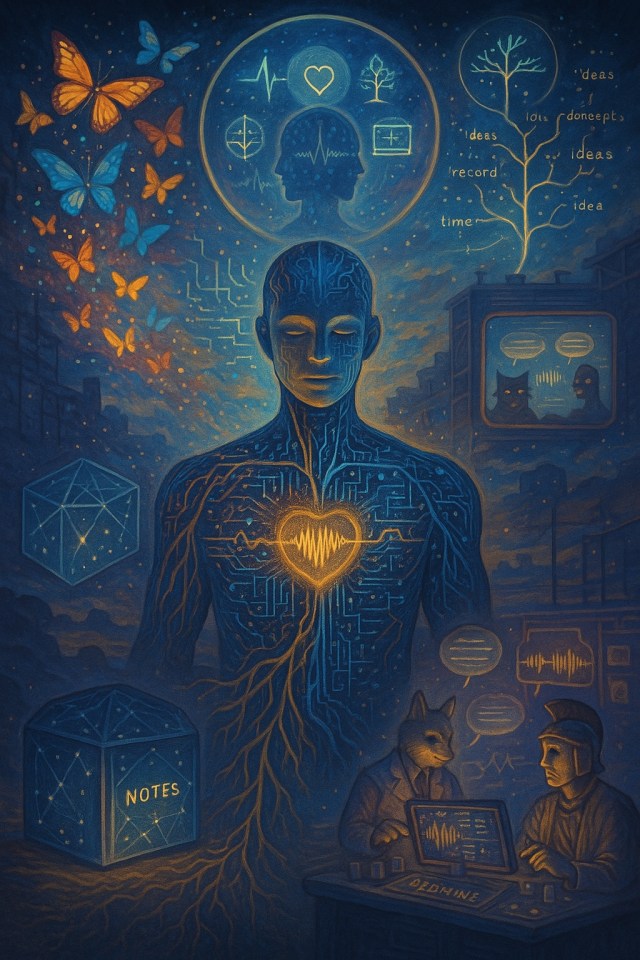
“Most systems help you plan what to do. What if you had one that told the story of what you’ve already done — and what it actually meant?”
I live in a whirlwind of ideas. ADHD often feels like a blessing made of a hundred butterfly wings — each one catching a new current of thought. The challenge isn’t creativity. It’s capture, coherence, and context.
So I began building a system. One that didn’t just track what I do — but understood it, reflected it, and grew with me.
🎯 CauseAndEffect: The Heartbeat of Causality
It started with a simple idea: If I log what I’m doing, I can learn from it.
But CauseAndEffect evolved into more than that.
Now, with a single keystroke, I can mark a moment:
📝 “Started focus block on Project Ember.”
Behind the scenes:
- It captures a screenshot of my screen
- Uses a vision transformer to understand what I’m working on
- Tracks how long I stay focused, which apps I use, and how often I switch contexts
- Monitors how this “cause” plays out over time
If two weeks later I’m more productive, it can tell me why. If my focus slips, it shows me what interrupted it.
This simple tool became the pulse of my digital awareness.
🧠 MindMapper Mode: From Tangent to Thought Tree
When you think out loud, ideas scatter. That’s how I work best — but I used to lose threads faster than I could follow them.
So I built MindMapper Mode.
It listens as I speak (live or from a recorded .wav), transcribes with Whisper, and parses meaning with semantic AI.
Then it builds a mind map — one that lives inside my Obsidian vault:
- Main ideas become the trunk
- Tangents and circumstantial stories form branches
- When I return to a point, the graph loops back
From chaos to clarity — in real time.
It doesn’t flatten how I think. It captures it. It honors it.
📒 Obsidian: The Vault of Living Memory
Obsidian turned everything from loose ends into a linked universe.
Every CauseAndEffect entry, every MindMap branch, every agent conversation and weekly recap — all saved as markdown, locally.
Everything’s tagged, connected, and searchable.
Want to see every time I broke through a block? Search #breakthrough. Want to follow a theme like “Morning Rituals”? It’s all there, interlinked.
This vault isn’t just where my ideas go. It’s where they live and evolve.
🗂️ Redmine: Action, Assigned
Ideas are great. But I needed them to become something.
Enter Redmine, where tasks come alive.
Every cause or insight that’s ready for development is turned into a Redmine issue — and assigned to AI agents.
- Logical Dev agents attempt to implement solutions
- Creative QA agents test them for elegance, intuition, and friction
- Just like real dev cycles, tickets bounce back and forth — iterating until they click
- If the agents can’t agree, it’s flagged for my manual review
Scrum reviews even pull metrics from CauseAndEffect:
“Here’s what helped the team last sprint. Here’s what hurt. Here’s what changed.”
Reflection and execution — woven together.
🎙️ Emergent Narratives: A Podcast of Your Past
Every Sunday, my system generates a radio-style recap, voiced by my AI agents.
They talk like cohosts.
They reflect on the week.
They make it feel like it mattered.
🦊 STARR: “That Tuesday walk? It sparked a 38% increase in creative output.”
🎭 CodeMusai: “But Wednesday’s Discord vortex… yeah, let’s not repeat that one.”
These episodes are saved — text, audio, tags. And after four or five?
A monthly meta-recap is generated: the themes, the trends, the storyline.
All of it syncs back to Obsidian — creating a looping narrative memory that tells users where they’ve been, what they’ve learned, and how they’re growing.
But the emergent narrative engine isn’t just for reflection. It’s also used during structured sprint cycles. Every second Friday, the system generates a demo, retrospective, and planning session powered by Redmine and the CauseAndEffect metrics.
- 🗂️ Demo: Showcases completed tasks and AI agent collaboration
- 🔁 Retro: Reviews sprint performance with context-aware summaries
- 🧭 Planning: Uses past insights to shape upcoming goals
In this way, the narrative doesn’t just tell your story — it helps guide your team forward.
But it doesn’t stop there.
There’s also a reflective narrative mode — a simulation that mirrors real actions. When users improve their lives, the narrative world shifts with them. It becomes a playground of reflection.
Then there’s freeform narrative mode — where users can write story arcs, define characters, and watch the emergent system breathe life into their journeys. It blends authored creativity with AI-shaped nuance, offering a whole new way to explore ideas, narratives, and identity.
📺 Narrative Mode: Entertainment Meets Feedback Loop
The same emergent narrative engine powers a new kind of interactive show.
It’s a TV show — but you don’t control it directly. You nudge it.
Go on a walk more often? The character becomes more centered.
Work late nights and skip meals? The storyline takes a darker tone.
It’s not just a game. It’s a mirror.
My life becomes the input. The story becomes the reflection.
🌱 Final Thought
This isn’t just a system. It’s my second nervous system.
It lets you see why your weeks unfolded the way they do.
It catches the threads when you forgot where they began.
It reminds you that the chaos isn’t noise — it’s music not yet scored.
And now, for the first time, it can be heard clearly.
 SeeingSharp