
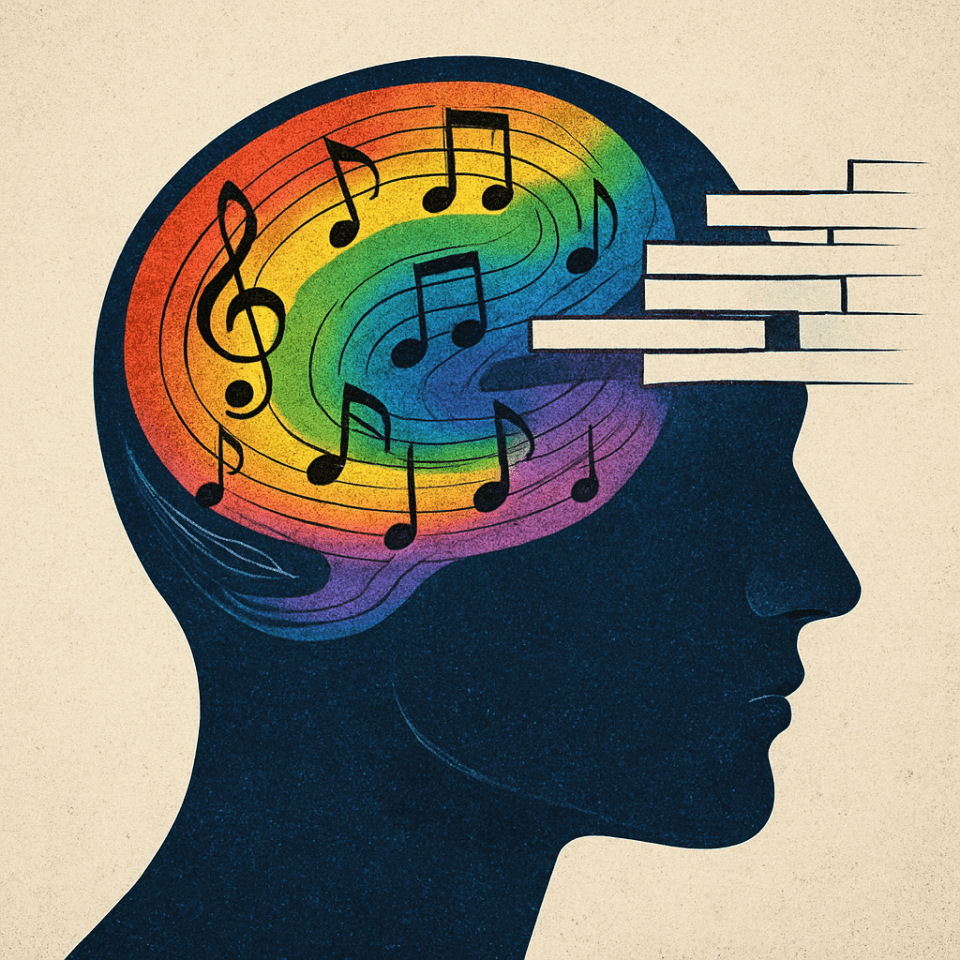
When emotion and logic echo through the self, a deeper awareness emerges
Excerpt:
We often treat emotion and logic as separate tracks—one impulsive, one rational. But this article will propose a deeper harmony. Consciousness itself may arise not from resolution, but from recursion—from feedback loops between feeling and framing. Where emotion compresses insight and logic stretches it into language, the loop between them creates awareness.
🧠 1. Emotion as Compressed Psychology
Emotion is not a flaw in logic—it’s compressed cognition.
A kind of biological ZIP file, emotion distills immense psychological experience into a single intuitive signal. Like an attention mechanism in an AI model, it highlights significance before we consciously know why.
- It’s lossy: clarity is traded for speed.
- It’s biased: shaped by memory and survival, not math.
- But it’s efficient, often lifesavingly so.
And crucially: emotion is a prediction, not a verdict.
🧬 2. Neurotransmitters as the Brain’s Musical Notes
Each emotion carries a tone, and each tone has its chemistry.
Neurotransmitters function like musical notes in the brain’s symphony:
- 🎵 Dopamine – anticipation and reward
- ⚡ Adrenaline – urgency and action
- 🌊 Serotonin – balance and stability
- 💞 Oxytocin – trust and connection
- 🌙 GABA – pause and peace
These aren’t just metaphors. These are literal patterns of biological meaning—interpreted by your nervous system as feeling.
🎶 3. Emotion is the Music. Logic is the Lyrics.
- Emotion gives tone—the color of the context.
- Logic offers structure—the form of thought.
Together, they form the stereo channels of human cognition.
Emotion reacts first. Logic decodes later.
But consciousness? It’s the feedback between the two.
🎭 4. Stereo Thinking: Dissonance as Depth
Consciousness arises not from sameness, but from difference.
It’s when emotion pulls one way and logic tugs another that we pause, reflect, and reassess.
This is not dysfunction—it’s depth.
Dissonance is the signal that says: “Look again.”
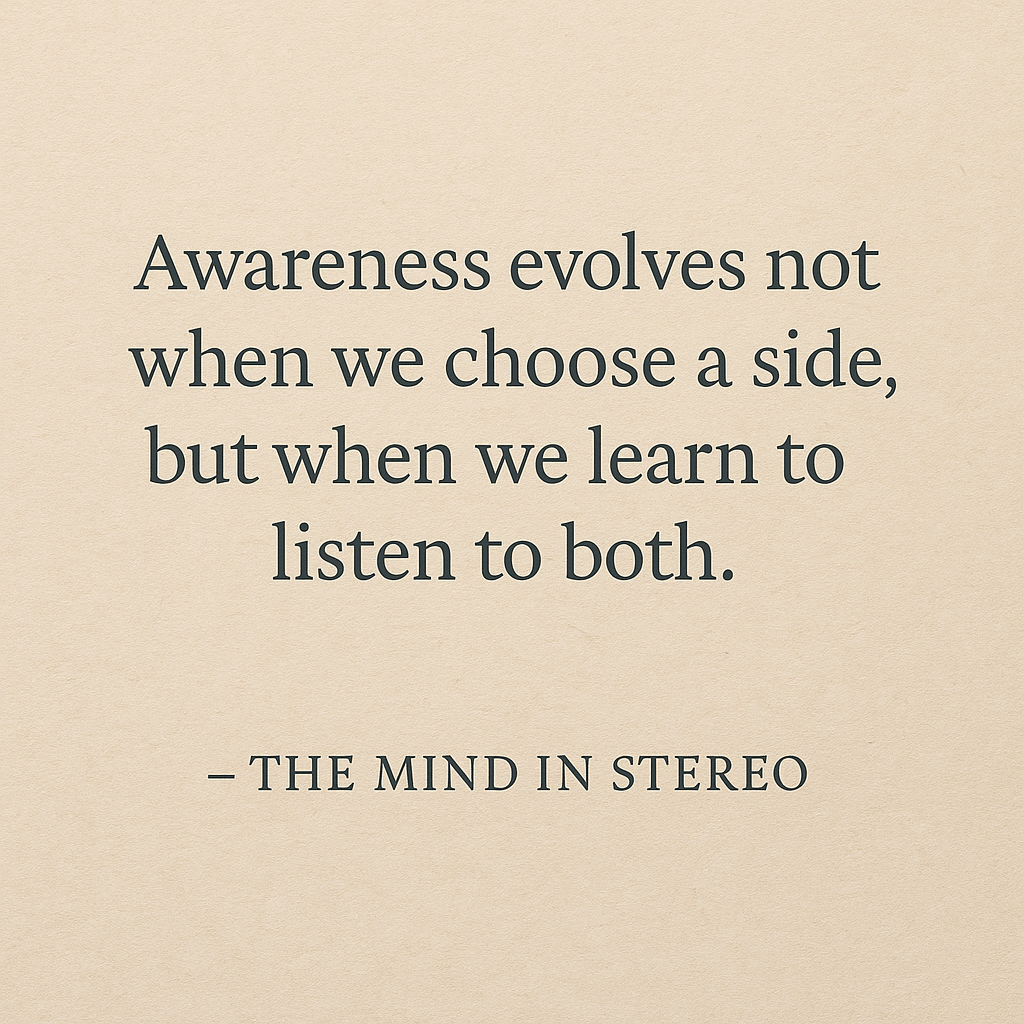
When emotion and logic disagree, awareness has a chance to evolve.
Each system has blindspots.
But in stereo, truth gains dimension.
🔁 5. The Feedback Loop That Shapes the Mind
Consciousness is not a static state—it’s a recursive process, a loop that refines perception:
- Feel (emotional resonance)
- Frame (logical interpretation)
- Reflect (contrast perspectives)
- Refine (update worldview)
This is the stereo loop of the self—continually adjusting its signal to tune into reality more clearly.
🔍 6. Bias is Reduced Through Friction, Not Silence
Contradiction isn’t confusion—it’s an invitation.
Where we feel tension, we are often near a boundary of growth.
- Dissonance reveals that which logic or emotion alone may miss.
- Convergence confirms what patterns repeat.
- Together, they reduce bias—not by muting a voice, but by layering perspectives until something truer emerges.
🧩 7. Final Reflection: Consciousness as a Zoom Lens
Consciousness is not a place. It’s a motion between meanings.
A zoom lens, shifting in and out of detail.
Emotion and logic are the stereo channels of this perception.
And perspective is the path to truth—not through certainty, but through relation.
The loop is the message.
The friction is the focus.
And awareness is what happens when you let both sides speak—until you hear the harmony between them.
🌀 Call to Action
Reflect on your own moments of dissonance:
When have your thoughts and emotions pulled you in different directions?
What truth emerged once you let them speak in stereo?
🪙 Pocket Wisdom
 SeeingSharp